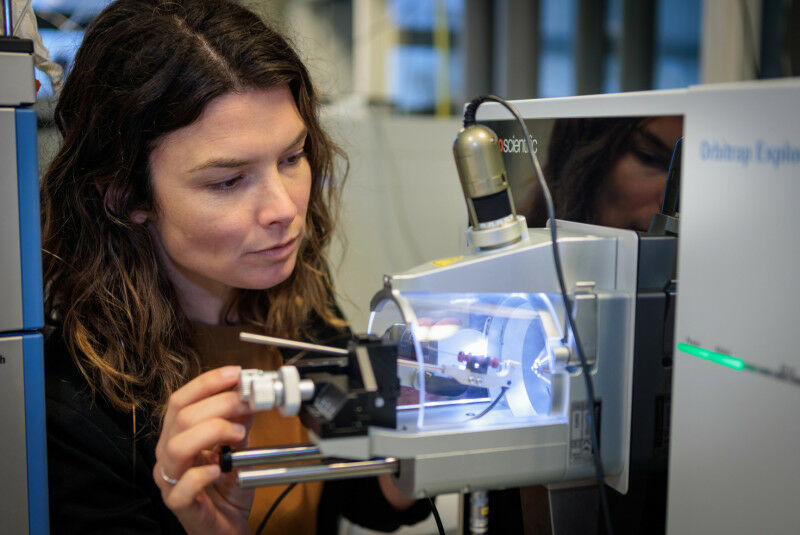
Kelly Stecker working on her research in the Biomolecular Mass Spectrometry Lab
Kelly Stecker working on her research in the Biomolecular Mass Spectrometry Lab By mapping the proteins present in breast cancer cells, researchers Donna Debets and Kelly Stecker from the AltelaarLab investigated how one can predict the effectiveness of conventional treatment for HER2 positive breast cancer. The study sheds light on the why and how behind breast cancer's diverse responses to treatment, presenting a step towards personalised oncology. The research is a joint effort of Utrecht University and the Netherlands Cancer Institute and was recently published in Cell Reports Medicine . Breast cancer is a heterogenous disease, that evolves differently from person to person. Because of the variety in tumors, a certain type of treatment sometimes works for one person, but not for the other. This is also the case with a subtype of breast cancer, HER2 positive or HER2+ breast cancer. Even though all forms of HER2+ breast cancer are triggered by an upregulated protein (the Human Epidermal growth factor Receptor 2 or HER2), 20-40% of the patients suffering from this type of cancer do not respond to HER2-targeted treatment.
TO READ THIS ARTICLE, CREATE YOUR ACCOUNT
And extend your reading, free of charge and with no commitment.