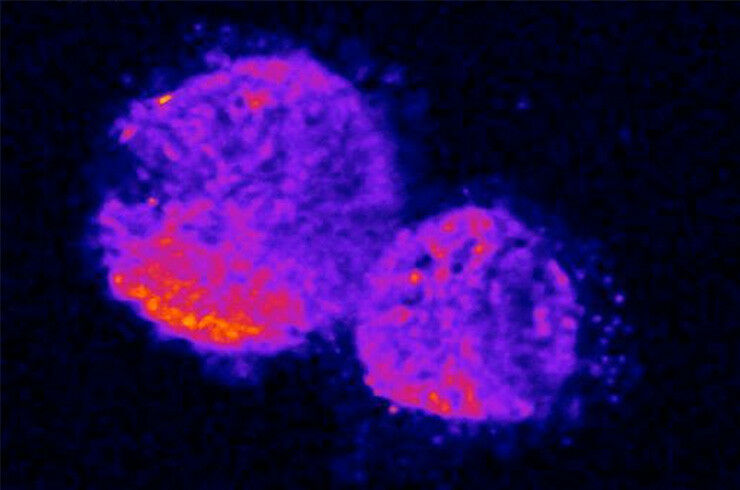
FMI researchers discovered a ’walkie-talkie’ mechanism that allows a developing embryo’s cells to sync up. Photo credits: Georgios Misailidis
FMI researchers discovered a 'walkie-talkie' mechanism that allows a developing embryo's cells to sync up. Photo credits: Georgios Misailidis - Scientists have known that when a mouse embryo is developing, the cells that will become its spine and muscles switch specific genes on and off repeatedly, in a synchronous fashion. However, there are deep mysteries about how these cells synchronize. FMI researchers have now developed a mathematical model that not only better explains how spontaneous synchronization arises in a developing mouse embryo, but may also offer some fundamental clues about how other biological systems sync up. From fireflies flashing together to an audience's applause falling into a beat to neurons firing in sync, life offers many examples of spontaneous synchronization across populations. In the developing mouse embryo, for example, synchronous waves of gene-expression patterns across cells drive the formation of tissue segments that then develop into vertebrae and skeletal muscle. While the current go-to model of synchronous systems has captured the basic mechanism underlying this process, it couldn't explain what information cells exchange and what the cells do with the information they get.
TO READ THIS ARTICLE, CREATE YOUR ACCOUNT
And extend your reading, free of charge and with no commitment.