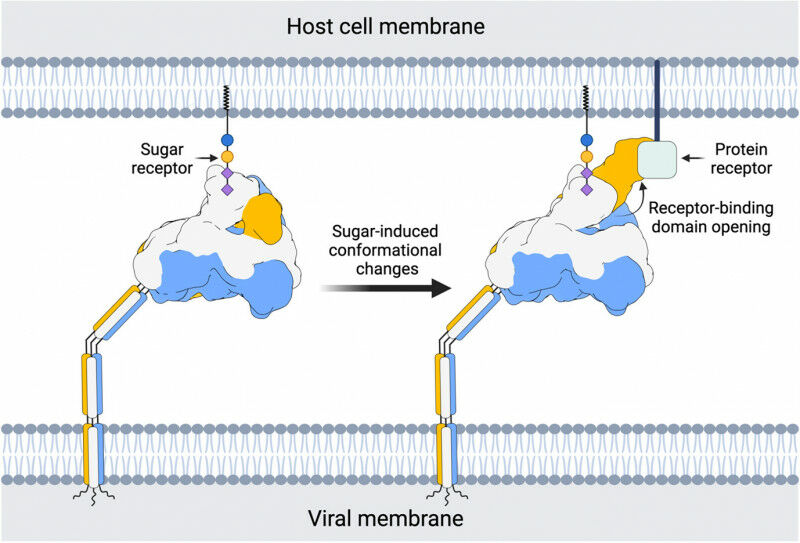
Proposed model for how human coronavirus HKU1 engages the host cell. The spike protein tilts towards the host cell membrane so that it can bind to its primary sugar receptor.
Proposed model for how human coronavirus HKU1 engages the host cell. The spike protein tilts towards the host cell membrane so that it can bind to its primary sugar receptor. Researchers from the Utrecht University have uncovered a sophisticated mechanism by which coronavirus spike proteins can be activated for cell entry. The study , published today in the scientific journal Nature, used powerful microscopes and computer simulations to reveal how a tiny sugar molecule binds to a human coronavirus spike and triggers exposure of components that are required to invade the host cell. These findings provide new fundamental insights into the complex mechanisms that coronavirus may use to evade the immune system and initiate an infection. Coronavirus spikes play a crucial role in virus attachment and entry into our cells. An in-depth understanding of these proteins is important because they are key factors for transmission between species and the main targets for neutralising antibodies.
TO READ THIS ARTICLE, CREATE YOUR ACCOUNT
And extend your reading, free of charge and with no commitment.