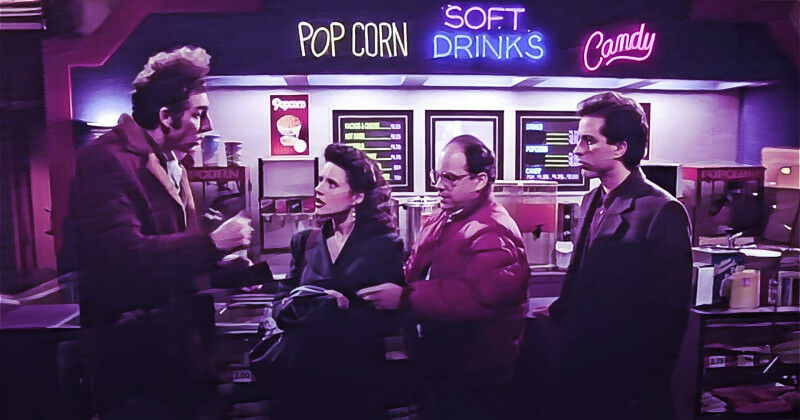
Illustration of a scene from the classic Seinfeld episode, ’The Movie.’ (Illustration by Rob Potter)
Illustration of a scene from the classic Seinfeld episode, 'The Movie.' (Illustration by Rob Potter) - If you have ever laughed at a joke despite not finding it funny, or laughed at something and weren't sure why, you have proven that comprehending and appreciating humour are two very different things. Western University neuroscientists have now discovered that two distinct parts of the brain trigger these reactions, a result that also may shed light on why some patients with Parkinson's disease might have difficulty being 'in' on a joke. For the study, healthy participants were examined in a functional magnetic resonance imaging (fMRI) scanner while listening to a series of audio-recorded jokes and watching an episode of the classic TV series, Seinfeld . Maggie Prenger "It was very easy to find participants," said Schulich School of Medicine & Dentistry MD/PhD candidate and study lead author Margaret Prenger. "Who doesn't want to lie down for an hour in a cozy MRI and watch Seinfeld ?" During the fMRI scan of the healthy participants, two distinct regions of the brain showed increased activity when a joke's punchline was delivered or Jerry, George, Elaine or Kramer said or did something funny. The dorsal striatum, a brain area involved in working memory, processing ambiguity and cognitive flexibility, fired up, indicating the joke was understood or the participant 'got it' and shortly after that, the ventral striatum, critical in reward-processing and enjoyment, ignited too, showing they thought the punchline or moment was funny, or at least they appreciated the humour.in "Our main hypothesis is that these different sub-regions of the striatum are involved in humour comprehension and humour appreciation," said Prenger.
TO READ THIS ARTICLE, CREATE YOUR ACCOUNT
And extend your reading, free of charge and with no commitment.