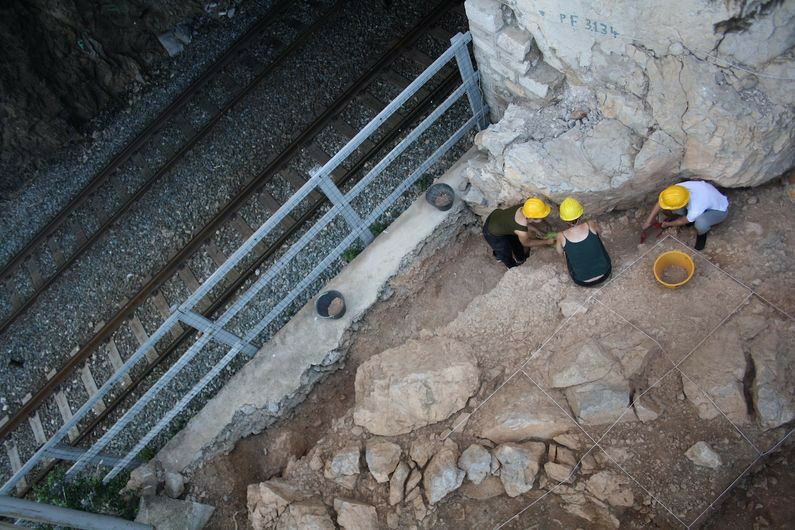
Riparo Bombrini during excavation Credit: Fabio Negrino
Riparo Bombrini during excavation Credit: Fabio Negrino An Italian study involving UdeM researchers shows new evidence that humans and Neanderthals milled flour as long as 43,000 years ago, several thousand years before what was previously thought, making Long before the invention of agriculture, humans already knew how to process cereals and other wild plants into a flour suitable for food - and now there's new evidence they did so long before scientists was previously thought. Published last week [June 10] in Quaternary Science Reviews, an Italian-led study of five ancient grindstones from around 39,000 to 43,000 years ago shows that milling for food dates back to the transitional period between Neanderthals and Homo sapiens . "This pushes back by several thousand years the earliest evidence of plant processing and flour production," said study co-author Julien Riel-Salvatore, an Université de Montréal professor who chairs the anthropology department. "One pestle from Riparo Bombrini, a site in northern Italy that I and my University of Genoa colleague Fabio Negrino have been working on for over 20 years, shows Neanderthals also engaged in this behavior, which is something completely new, to our knowledge. "So it's a pretty major discovery." The Neanderthal-to- Homo sapiens period was characterised by the coexistence of the Late Mousterian (Neanderthal), Uluzzian and Protoaurignacian ( H. sapiens ) techno-complexes in the northwest and southwest of present-day Italy.
TO READ THIS ARTICLE, CREATE YOUR ACCOUNT
And extend your reading, free of charge and with no commitment.