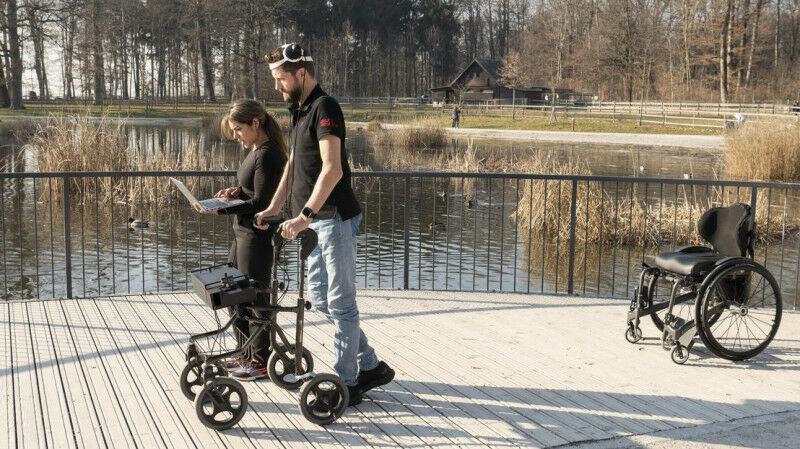
Gert-Jan et Andrea Galvez, doctorante, marchant au Lac de Sauvabelin à Lausanne. Photo Gilles Weber, CC-BY-SA
Gert-Jan et Andrea Galvez, doctorante, marchant au Lac de Sauvabelin à Lausanne. Photo Gilles Weber, CC-BY-SA Neuroscientists and neurosurgeons from EPFL/CHUV/UNIL and CEA/CHUGA/UGA report in the journal Nature that they have re-established the communication between the brain and spinal cord with a wireless digital bridge, allowing a paralyzed person to walk again naturally "We have created a wireless interface between the brain and the spinal cord using brain-computer interface (BCI) technology that transforms thought into action.", summarizes Grégoire Courtine, Professor of Neuroscience at EPFL, CHUV and UNIL. Published in the journal Nature , "Walking naturally after spinal cord injury using a brain-spine interface" presents the situation of Gert-Jan, 40 years old, who suffered a spinal cord injury following a bicycle accident that left him paralyzed. The digital bridge enabled him to regain natural control over the movement of his paralyzed legs, allowing him to stand, walk, and even climb stairs. Gert-Jan explains that he has recovered the pleasure of being able to share a beer standing at a bar with friends : "This simple pleasure represents a significant change in my life". A digital bridge involving two electronic implants: one on the brain, the other on the spinal cord - To establish this digital bridge, two types of electronic implants are needed. Neurosurgeon Jocelyne Bloch, who is a professor at CHUV, UNIL and EPFL, explains: "We have implanted WIMAGINE devices above the region of the brain that is responsible for controlling leg movements.
TO READ THIS ARTICLE, CREATE YOUR ACCOUNT
And extend your reading, free of charge and with no commitment.