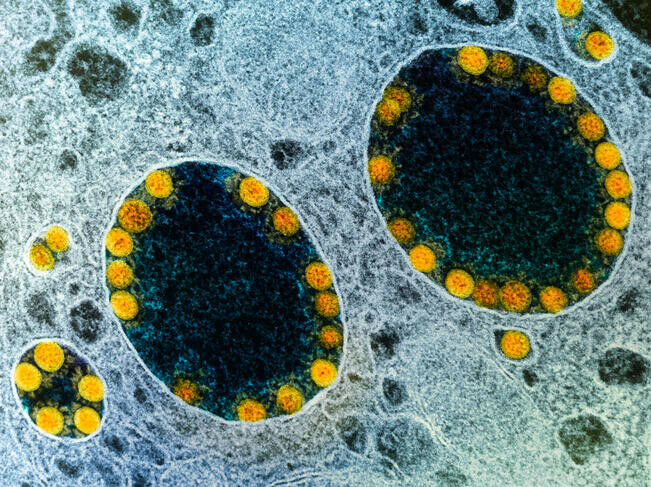
Transmission electron micrograph (false colours) showing a large number of Sars-CoV-2 viral particles (yellow) in a cell of the olfactory epithelium.
Transmission electron micrograph (false colours) showing a large number of Sars-CoV-2 viral particles ( yellow ) in a cell of the olfactory epithelium. By depriving them more or less temporarily of their sense of smell, the Covid-19 pandemic made thousands of people abruptly realise the importance of their olfactory system. Research is now trying to decipher the causes of anosmia and to improve its treatment. In humans, smell is often - wrongly - considered as a secondary sense. It is nevertheless omnipresent. "Each time we breathe in, we sample odorant molecules in the environment that enable us to detect the presence of objects that may be of value in terms of our protection, our diet or our relationships with others", explains Moustafa Bensafi, CNRS research professor within the Neuropop team of the Lyon Neuroscience Research Centre (CNRL) 1 . "A sense of smell allows us to detect smoke, stale food or even the presence of an animal that might be dangerous or familiar.
TO READ THIS ARTICLE, CREATE YOUR ACCOUNT
And extend your reading, free of charge and with no commitment.