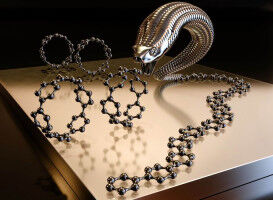
How life appeared: rise of the nanomachines
Chemists at UdeM explain how molecular systems at the origin of life may have evolved, a development that could lead to new and improved nanosystems. By attaching molecules together, scientists at Université de Montréal think they've found how molecular systems at the origin of life evolved to create complex self-regulating functions. Published today in the European journal Angewandte Chemie, their findings promise to provide chemists and nanotechnologists with a simple strategy to create the next generation of dynamic nanosystems. Life on Earth is sustained by millions of different tiny nanostructures or nanomachines that have evolved over millions of years, explained Alexis Vallée-Bélisle, an UdeM professor and principal investigator of the study. These structures, often smaller than 10,000 times the diameter of a human hair, are typically composed of proteins or nucleic acids. While some are made from a single component or part (often linear polymers that fold into a specific structure), most of them are made using several components that spontaneously assemble into large and dynamic assemblies. Responding to stimuli. "These molecular assemblies are highly dynamic and activate or deactivate precisely in response to various stimuli such as a variation in temperature, oxygen, or nutrients," said Vallée-Bélisle. "Similarly to cars that require sequential ignition, brake release, gear change and gas input to move forward, molecular systems require the sequential activation or deactivation of various nanomachines to perform any specific tasks ranging from moving, breathing to thinking." The researchers raised a fundamental question: how have dynamic molecular assemblies been created, programmed and fine-tuned to support life?