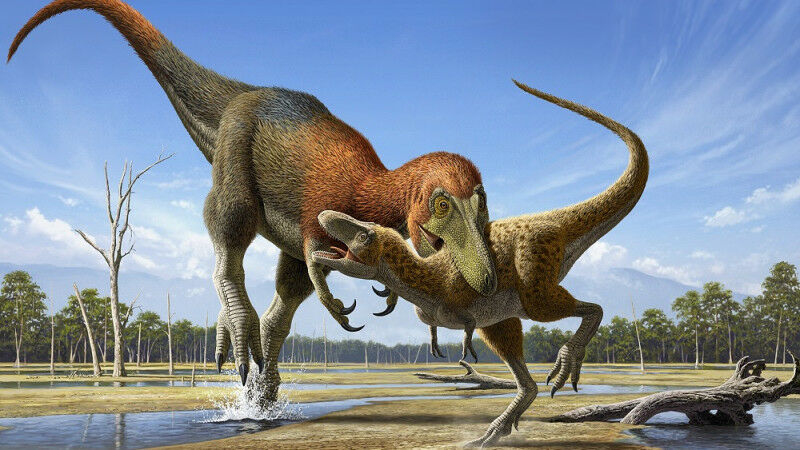
For decades, paleontologists have debated whether Nanotyrannus is a separate species or simply a juvenile T. rex. (Credit Raul Martin)
For decades, paleontologists have debated whether Nanotyrannus is a separate species or simply a juvenile T. rex. (Credit Raul Martin) - Nanotyrannus was a smaller, longer-armed relative of T. rex, with a narrower snout. Published on Wednesday 3 January 2024 Last updated on Wednesday 3 January 2024 - A new analysis of fossils believed to be juveniles of T. rex now shows they were adults of a small tyrannosaur, with narrower jaws, longer legs, and bigger arms than T. rex . The species, Nanotyrannus lancensis , was first named decades ago but later reinterpreted as a young T. rex . The first skull of Nanotyrannus was found in Montana in 1942, but for decades, paleontologists have gone back and forth on whether it was a separate species, or simply a juvenile of the much larger T. rex . Dr Nick Longrich, from the Milner Centre for Evolution in the Department of Life Sciences at the University of Bath (UK), and Dr Evan Saitta, from the University of Chicago (USA) re-analysed the fossils, looking at growth rings, the anatomy of Nanotyrannus , and a previously unrecognized fossil of a young T. rex . Measuring the growth rings in Nanotyrannus bones, they showed that they became more closely packed towards the outside of the bone - its growth was slowing.
TO READ THIS ARTICLE, CREATE YOUR ACCOUNT
And extend your reading, free of charge and with no commitment.