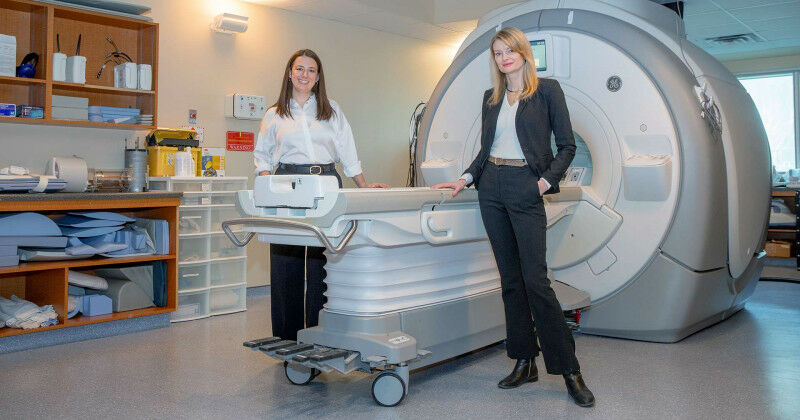
Researchers Emily Nichols (left) and Emma Duerden with the 3T MRI scanner at Western’s Translational Imaging Research Facility. (Christopher Kindratsky)
Researchers Emily Nichols ( left ) and Emma Duerden with the 3T MRI scanner at Western's Translational Imaging Research Facility. (Christopher Kindratsky) A new study shows oxygenation levels in the placenta, formed during the last three months of fetal development, are an important predictor of cortical growth (development of the outermost layer of the brain or cerebral cortex) and is likely a predictor of childhood cognition and behaviour. Emma Duerden (Christopher Kindratsky/ Western Communications photo) "Many factors can disrupt healthy brain development in utero , and this study demonstrates the placenta is a crucial mediator between maternal health and fetal brain health," said Emma Duerden , Canada Research Chair in Neuroscience & Learning Disorders at Western University, Lawson Health Research Institute scientist and senior author of the study. The connection between placental health and childhood cognition was demonstrated in previous research using ultrasound, but for this study, Duerden, research scientist Emily Nichols and an interdisciplinary team of Western and Lawson researchers used magnetic resonance imaging (MRI), a far superior and more holistic imaging technique. This novel approach to imaging placental growth allows researchers to study neurodevelopmental disorders very early on in life, which could lead to the development of therapies and treatments. "While ultrasound provides some measure of placental function, it is imprecise and prone to error, so MRI is just a bit more specific and precise," said Nichols, lead author of the study.
TO READ THIS ARTICLE, CREATE YOUR ACCOUNT
And extend your reading, free of charge and with no commitment.