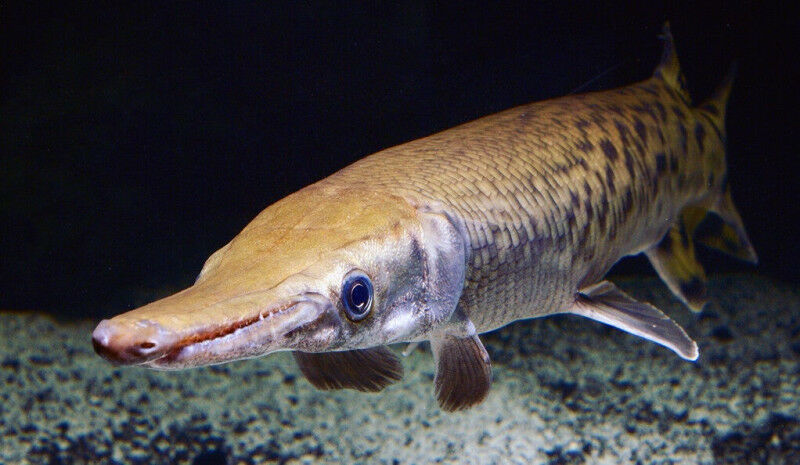
The alligator gar, and other gar species, are ’living fossils’ that it shows little species diversity or physical differences from ancestors that lived tens of millions of years ago. (Photo by Solomon David)
The alligator gar, and other gar species, are 'living fossils' that it shows little species diversity or physical differences from ancestors that lived tens of millions of years ago. (Photo by Solomon David) - Yale researchers have discovered evidence of why a fish group, considered "living fossils," has existed largely unchanged for tens of millions of years. In 1859, Charles Darwin coined the term "living fossils" to describe organisms that show little species diversity or physical differences from their ancestors in the fossil record. In a new study, Yale researchers provide the first evidence of a biological mechanism that explains how living fossils occur in nature. [T]his is the first instance where science is showing that a lineage, through an intrinsic aspect of its biology, fits the criteria of living fossils. Thomas J. Near The study, published in the journal Evolution , shows that gars - an ancient group of ray-finned fishes that fit the definition of a living fossil - have the slowest rate of molecular evolution among all jawed vertebrates, meaning their genome changes more slowly than those of other animals. By linking this finding to the process of hybridization - when two different species produce viable offspring - of gar species in the wild that last shared common ancestry during the age of the dinosaurs, the researchers demonstrate that slow evolution rate of their genome drives their low species diversity.
TO READ THIS ARTICLE, CREATE YOUR ACCOUNT
And extend your reading, free of charge and with no commitment.