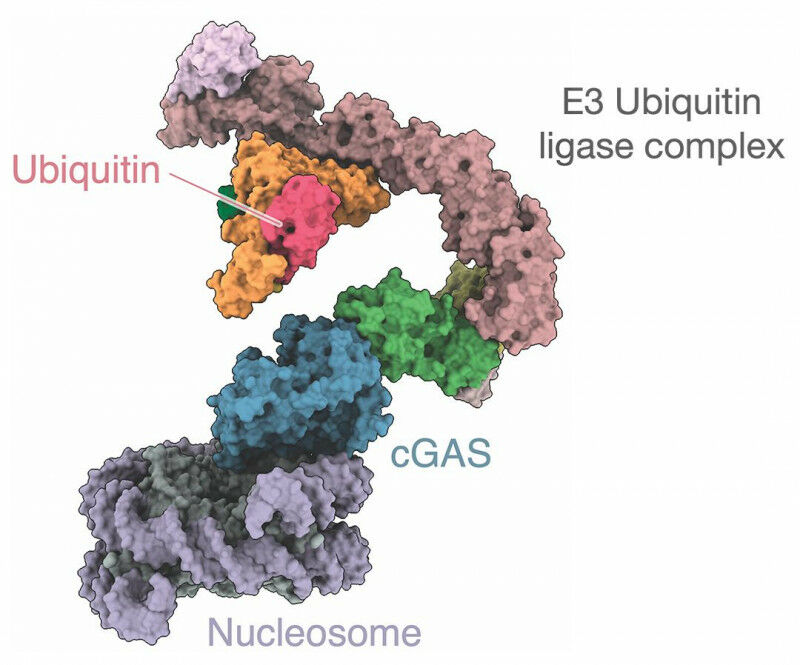
CGAS with a ubiquitin attached. Credit: Xu et al 2024, Nature 10.1038/s41586’024 -07112-w
CGAS with a ubiquitin attached. Credit: Xu et al 2024, Nature 10.1038/s41586'024 -07112-w Scientists at EPFL uncover the mechanism by which cells mark the protein cGAS for degradation, which is critical in preventing the immune system from mistakenly attacking the body's own tissues. A microscopic battle rages in our bodies, as our cells constantly fend off invaders through our immune system, a complex system of cells and proteins designed to protect us from harmful pathogens. One of its central components is the enzyme cyclic GMP-AMP synthase (cGAS), which acts as a sentinel, detecting foreign DNA and initiating an immune response. However, the immune system requires precise regulation to prevent cGAS from mistakenly attacking the body's own tissues, leading to autoimmune disorders, which now affect about 10% of the global population. Previous studies have revealed a little of how this happens. During cell division - mitosis - the membrane that protects the cell's nucleus, the nuclear envelope, breaks down and cGAS quickly relocates into the nucleus. There, it attaches itself to nucleosomes - the basic structural unit of DNA packaging in the cell - and becomes covered by another protein called BAF. All this ensures that cGAS stays inactive and fixed in place, and does not mistakenly interact with the cell's own DNA. It represents a sophisticated balance between immune readiness and protecting the integrity of the cell's genome. The question is, how does the cell coordinate this with its other everyday functions?
TO READ THIS ARTICLE, CREATE YOUR ACCOUNT
And extend your reading, free of charge and with no commitment.