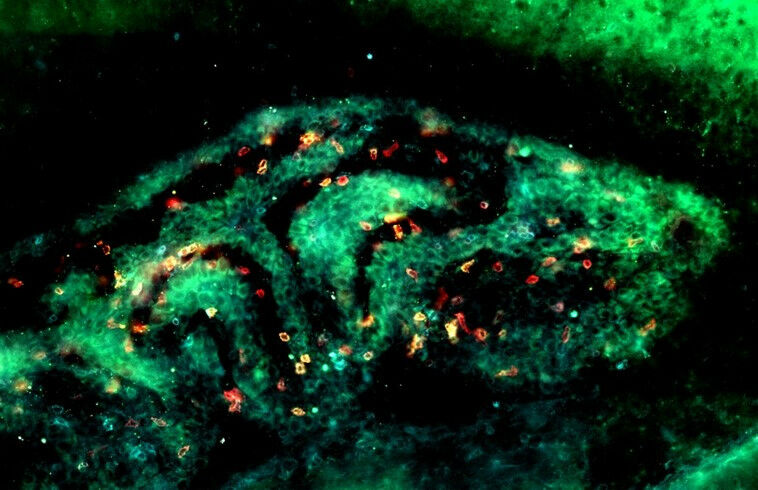
Labeling of cytotoxic T lymphocytes (CD8 in red and the "residence" marker CD103 in green) lodged in the choroid plexus of a parasite-infected brain
Toxoplasmosis is an infection caused by a parasite called Toxoplasma gondii (T. gondii). In over a third of the human population, this parasite establishes a chronic brain infection that can have serious consequences in people with weakened immunity. A better understanding of the immune mechanisms involved in controlling this infection is essential if we are to develop new therapeutic strategies, as there is currently no treatment available to eliminate the persistent form of the parasite. The study, carried out by Inserm researcher Nicolas Blanchard and his team at the Institut Toulousain des maladies infectieuses et inflammatoires (Infinity, Université Toulouse III Paul Sabatier, CNRS, Inserm), showed that a class of immune cells, CD8+ "resident" T lymphocytes, play a key role in detecting and neutralizing the toxoplasmosis parasite in the brain. These results, published in the journal PNAS , point to new avenues of treatment to eliminate persistent forms of toxoplasmosis.
Toxoplasmosis is a widespread parasitic infection in humans. One person in three, or even one in two in some countries, has been exposed to this parasite in his or her lifetime. The parasite is transmitted by direct contact with the excrement of a feline carrying the T. gondii parasite, or by eating contaminated food (undercooked meat, raw fruit and vegetables).
The consequences of this infection vary from person to person. In healthy people, the consequences of this infection are usually not serious: the infection may cause fever and fatigue, but the symptoms often go unnoticed. However, the parasite is not eliminated from the body. It can persist in a "latent" form in muscles, the retina and the brain. A growing body of evidence suggests that this chronic brain infection is associated with behavioral changes, and even an acceleration of neurodegenerative phenomena. What’s more, in people with compromised immunity, such as those suffering from AIDS or using certain immunosuppressive treatments (e.g. transplants), the consequences can be severe, as the parasite can reactivate in the brain, causing potentially fatal brain inflammation (known as cerebral toxoplasmosis or neurotoxoplasmosis).
To date, there is no treatment available to eliminate the persistent form and definitively eradicate the parasite. A better understanding of the immune mechanisms that control the parasite, particularly in the brain, could suggest new therapeutic strategies aimed at stimulating natural immunity to the parasite in order to better contain or even eliminate it.
The research team had already shown that particular immune cells, known as CD8+ T cells or "killer" T cells, play a key role in controlling the parasite in the brain. However, this is a highly heterogeneous cell population. For Inserm researcher Nicolas Blanchard and his team, it was crucial to identify which CD8+ T lymphocyte subtype was involved, in order to elucidate the mechanisms of immune surveillance of the parasite in the brain.
In 2009, a particular subtype of CD8+ T lymphocytes was discovered. These resident T lymphocytes are unique in that they do not patrol the body, but remain stationary in tissues, notably the brain. The role of the brain’s resident CD8+ T lymphocyte subpopulations in parasite neutralization and elimination had never been studied before.
To study this role, the researchers used an animal model mimicking the latent T. gondii infection found in humans. By selectively eliminating circulating or resident subpopulations, the team showed that control of the parasite in the brain is ensured by resident CD8+ T lymphocytes, as opposed to other lymphocytes that patrol lymphoid tissues and organs.
Researchers have also shown that resident CD8+ T cells are formed by signals from other immune cells, the CD4+ T cells.
" This result challenged us because it provides a better understanding of why people with HIV are potentially more vulnerable to cerebral toxoplasmosis . Indeed, HIV is known to reduce the number of CD4+ T lymphocytes, which could have a negative cascade impact on the formation of brain-resident CD8+ T lymphocytes, and thus alter immunity to the toxoplasmosis parasite," explains Nicolas Blanchard.
Armed with these results, scientists will now be able to think about strategies to try and improve the ability of resident lymphocytes to fight brain infection.
"Now that we have a better understanding of the surveillance mechanisms of the toxoplasmosis parasite in the brain, we are carrying out further work to understand the mechanisms put in place by the parasite to escape the control of CD8+ T lymphocytes, and how we can try to neutralize these mechanisms," concludes Nicolas Blanchard.