This new type of panel offers ecological and economic advantages over traditional gypsum panels
Would you trust a drywall panel in which gypsum has been replaced by earth and wood fibers? Chances are you’d greet the idea with a certain amount of skepticism, but a study published by two Laval University researchers in the journal Construction and Building Materials suggests that your distrust is unfounded.
In fact, the comparative study conducted by Professor Pierre Blanchet and postdoctoral fellow Simon Pepin, from the Department of Wood and Forest Sciences, shows that panels made from earth and wood fibers would have no reason to envy gypsum panels, while having a smaller ecological footprint.
Because of their many qualities, gypsum boards, commonly known as "gyproc sheets", are ubiquitous in North American buildings. In Quebec alone, nearly 65 million square meters of gypsum board are installed annually, equivalent to about 11,000 soccer fields.
Unfortunately, this material has a not inconsiderable drawback. "Although it is theoretically possible to recover and recycle gypsum wallboard, technical and economic constraints mean that it ends its useful life in landfill sites," points out Pierre Blanchet. In Quebec, this would represent nearly 200,000 tonnes of residues annually.
To manufacture the panels used in the study, the researchers used a raw material that couldn’t be more local: soil from the Université Laval campus. This soil was first dried and then sieved to remove coarse particles," explains Simon Pepin. "Water, glue and wood fibers (4% of the total weight) are then added to improve certain panel properties, such as flexibility. The mixture is then poured into a mold between two sheets of paper identical to those used in gypsum board production. Finally, it is left to dry for five days."
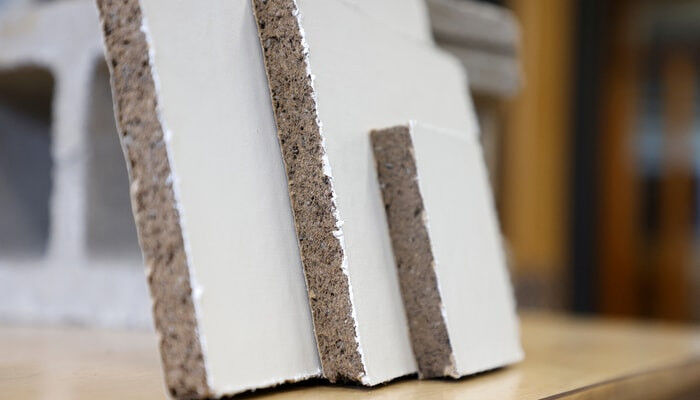
It’s no coincidence that these steps are similar to those used in the industrial production of gypsum board. "It’s deliberate so that they can eventually be produced in the same factories," explains Pierre Blanchet.
The researchers subjected their earth and wood fiber panels and gypsum boards to a series of tests to compare their hydric, mechanical (flexibility, strength), thermal and acoustic properties. simon Pepin sums up: "The performance of our panels is as good as or better than that of gypsum boards. Among other things, they are better at blocking sound, and their high water-storage capacity enables passive humidity control in a building. Their only weak point is their higher heat release rate at the start of the combustion test. This could be corrected by adding perlite or vermiculite to the mix of earth and wood fibers."
Despite the remarkable performance of earth and wood-fibre panels, Professor Blanchet is under no illusions. This study does not herald the end of gypsum board’s dominance in North America.
"On the other hand, the panel we are proposing could broaden the current offer and meet the needs of architects and building professionals looking for a material with a low environmental impact. Not only would these panels reduce the volume of gypsum board residue that goes to landfill, but by using an adhesive like cornstarch, we’d have a fully compostable material."
The study, published in Construction and Building Materials, is authored by Simon Pepin and Pierre Blanchet. The two researchers conduct their work at the Centre de recherche sur les matériaux renouvelables and the Centre de recherche sur les matériaux avancés.