Thanks to a project by the organizations newTree and tiipaalga, which is supported by the Swiss Ornithological Institute, migratory birds in Africa are finding suitable habitats - and people are also benefiting.
Many migratory birds that breed in Switzerland spend a large part of their lives in the Sahel region and the savannahs of West Africa. It is therefore crucial that they also find high-quality habitats with a rich food supply in Africa. But extreme weather events such as droughts and increasing pressure from human activities, such as growing livestock numbers and increasing logging, are causing deserts to form and cultivated land to become infertile.
This has a devastating impact on biodiversity, the functioning of ecosystems and ultimately also on the living conditions of the local population. In the face of these challenges, the two organizations newTree and tiipaalga are taking a holistic approach to restoring overused land in Burkina Faso. One of their flagship projects is regeneration using the "mise en défens" (MED) method.
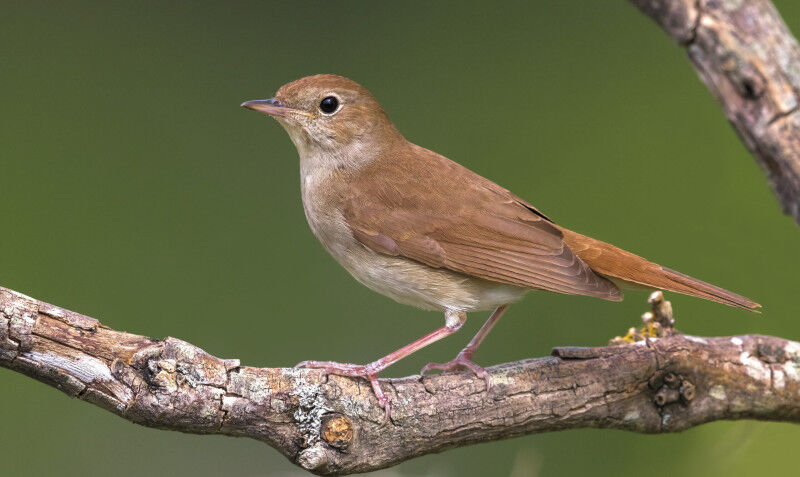
The principle consists of fencing in a degraded area of around three hectares to protect the vegetation from grazing by cattle, sheep and goats and allow it to regenerate naturally. In the last twenty years, over 450 such MEDs have been erected across the country - a success story! A study led by the Ornithological Institute shows that within a few years, MEDs develop into green islands with many resources and a high local plant diversity in an overused landscape. These habitats, revitalized by the natural power of self-regeneration, benefit migratory birds such as nightingales and redstarts.
People also benefit: These "islands of hope" provide fruits, nuts, medicinal plants and better harvests, which ultimately mean that the annual income of farming families doubles thanks to the support of newTree and tiipaalga. Our research shows that these measures enable farming families to improve their livelihoods in the long term and at the same time make an important contribution to the conservation of local and global biodiversity.
SOURCE
Marcacci, G., R. R. Kaboré, A. N. Zongo, S. T. Zoubga, B. Diakité, R. Spaar, F. Kaguembèga-Müller & A. Jacot (2025): The potential of farmer-managed small-scale grazing exclusions as an adaptive management to restore degraded lands in arid regions. Biol. Conserv. 302: 110949. https://doi.org/10.1016/j.biocon.2024.110949 .