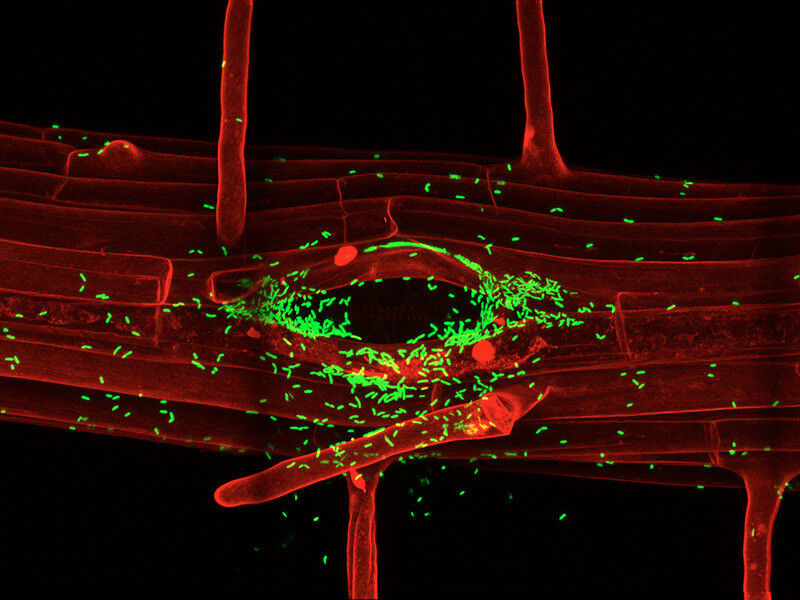
When we think of microbiota, we usually think of our gut. However, there is another, lesser-known type of microbiota that also plays a central role: the plant microbiota. In an article that appeared on the cover of the October 2, 2025 issue of "Science", Prof. Niko Geldner and his team at the University of Lausanne have unraveled the intricate web of the "phytobiota", where, sheltered underground, bacteria and roots cultivate a bittersweet love affair.
The plant microbiota, also known as the "phytobiota", is made up of communities of bacterial and fungal micro-organisms that are more or less mutualistic or symbiotic. Part of this microbiota, known as "rhizospheric" from the Greek "rhizo-" (root), is intimately associated with the roots. In order to build up a highly specialized rhizospheric microbiome, plants must selectively recruit soil bacteria. The plant’s well-being depends on it. Bacterial communities influence root development and consequently plant health in general. They give plants resilience in the face of a whole range of environmental stresses. The balance remains fragile, however, and in the event of plant weakness, certain microbes can also prove pathogenic.
A plant flow attractive to bacteria
But how do plants go about making this selection and shaping their microbial communities? Through the release of root exudates, a complex liquid that oozes from the plant. Although we know that this mixture of organic compounds plays a key role in bacterial colonization, little is known about how, when and where it is released, particularly on a spatial scale relevant to bacteria.
This is precisely the issue being investigated by the group led by Niko Geldner , full professor and director of the Department of Plant Molecular Biology (DBMV) at the Faculty of Biology and Medicine, University of Lausanne, in close collaboration with Dr. Feng Zhou’s laboratory at the Center for Excellence in Molecular Plant Science (CEMPS), Shanghai, and in partnership with German colleagues. Their results are published in the October 2, 2025 issue of the journal Science.
Similarities between the animal and plant kingdoms
To better understand the biologists’ research, a comparison is useful: like the intestinal epithelium of animals, root endodermis acts as a selective cellular barrier, restricting the free flow of mineral nutrients to the central vascular tissue of roots. Conversely, the endodermal barrier also plays a vital role in preventing the leakage of sugars, organic acids, amino acids and other energy-rich organic matter from photosynthesis into the soil, which is poor in these compounds. During its growth or branching, the root may experience moments and zones of vulnerability. for example, when a lateral root emerges from the mother root, part of the barrier is broken to facilitate the emergence of the rootlet," explains Niko Geldner, co-author of the article. If the broken barrier is subsequently repaired, the break causes a transient outward flow. We observed that bacteria clumped together and proliferated precisely at this point. The question was: what attracts them and makes them proliferate in this way?"
Hence the hypothesis put forward by the scientists: an alteration in the endodermal barrier must logically exert an influence on microbial recruitment and community composition. All that remained was to elucidate the mechanism behind this phenomenon. To this end, mutants of the model plant Arabidopsis thaliana, or Lady’s Slipper, with an absent or altered endodermal barrier, were used. our observations confirmed that alteration of the endodermal barriers profoundly affects bacterial colonization," says Niko Geldner. We therefore wondered whether the bacteria were fond of one or more substances in particular."
Using fluorescence to detect glutamine metabolism
The authors then looked for compounds whose concentration was increased in the root exudates of the mutants. They found a marked increase in amino acids, mainly glutamine, in their samples. Glutamine plays an important role in the transport of nitrogen to shoots.
This is where the expertise of Prof. Christoph Keel’s laboratory in the Department of Fundamental Microbiology at the University of Lausanne comes in. For several decades, he has been working on a very specific bacterium, Pseudomonas protegens CHA0, which thrives on various plants, including the roots of lady’s slipper, and can protect them from fungal diseases. Through genetic manipulation of this model bacterium, the biologists were able to demonstrate that these micro-organisms are highly attracted to glutamine. "We generated bacteria that lost their ability to -sense glutamine. As a result, they were unable to find the sites of rootlet emergence", reports Dr. Huei-Hsuan Tsai, a post-doctoral fellow in Prof. Geldner’s group and co-first author of the study. What’s more, the researchers were able to see first-hand that the bacteria do indeed use glutamine for growth, thanks to the development of a fluorescence system that only activates when glutamine is metabolized.
This amino acid thus constitutes a major signal that enables bacteria to find and colonize precise leakage sites on the root surface. "We have shown that bacteria metabolically adapt to this glutamine-rich niche and use glutamine as a carbon source, enabling them to proliferate even further," continues Huei-Hsuan Tsai.
Microbiota: an essential part of the solution
These diverse results provide evidence that localized glutamine leakage from the vascular system is an important factor in bacterial colonization. They illustrate the dynamic interactions between roots and microbes. In their future work, Niko Geldner and his team will attempt to gain a better understanding of which other substances are likely to attract bacteria, for example under various stress conditions: "Plants can indeed change the composition of their exudate according to the environmental constraints to which they are subjected (drought, extreme temperatures, salinity, lack of light, etc.) and therefore potentially attract other types of bacteria", Niko Geldner explains.
And what about a potential application in agriculture, given the drive to reduce fertilizers and pesticides in crops? "Despite the proven potential of bacteria, every soil is different and contains an immense variety of microbiota. So it’s extremely difficult to guarantee that a certain type of bacteria will take hold and protect a certain type of plant. For the moment, it’s very complicated to investigate what’s going on in the -real- earth. In the laboratory, we are trying to elucidate the basic principles by running simulations on simpler communities of bacteria, whose composition we have mastered. But one thing is certain: the microbiota is part of the health of our plant crops. If we don’t take it into account, we’ll never really understand what’s going on in our fields", concludes the specialist.