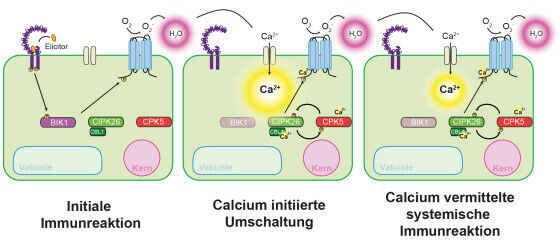
This causes a renewed influx of calcium into the neighbouring cells. In this way, the signal spreads without the affected cells themselves coming into contact with the pathogen. "Surprisingly, we observed that the intensity of the moving calcium signal is relatively weak and yet sufficient to activate the NADPH oxidase via the bi-kinase module. This is likely caused by sensitisation of this enzyme. We have elucidated the molecular mechanisms of this sensitisation," says Jörg Kudla. "We also suspect that this enables this weak calcium signal to spread from cell to cell without disrupting other signalling calcium-dependent processes that are occurring simultaneously in these cells." How exactly the cells regulate the strength of the calcium signal is not yet known.
For their investigation, the team combined various molecular genetic, cell biological and biochemical methods. The investigation of the propagation of calcium signals in tissues was carried out in transgenic plants of thale cress (Arabidopsis thaliana), in which the researchers analysed biosensor proteins for calcium using high-resolution microscopy. For further investigations, human cell cultures were used in which the plant signalling pathway was reconstituted.
Alongside the Kudla research group, Prof Iris Finkemeier’s group from the University of Münster was also involved in the project. The other authors are members of the research group headed by Prof Tina Romeis (formerly at the Free University of Berlin and now at the Leibniz Institute of Plant Biochemistry in Halle).