



Chemistry - Mar 19
Leipzig University and Center for the Transformation of Chemistry conclude collaboration agreement
Leipzig University and Center for the Transformation of Chemistry conclude collaboration agreement


Chemistry - Feb 2
New material for use in the chemical industry capable of transforming CO2 into high value-added compounds
New material for use in the chemical industry capable of transforming CO2 into high value-added compounds
Chemistry - Feb 2
Material for modulating metal-organic frameworks for use in the chemical industry capable of transforming CO2 into high value-added compounds
Material for modulating metal-organic frameworks for use in the chemical industry capable of transforming CO2 into high value-added compounds
Chemistry - Jan 15
University of Glasgow spin-out hails milestone breakthrough in hydrogen energy process
University of Glasgow spin-out hails milestone breakthrough in hydrogen energy process

Life Sciences - Dec 17
Manchester Institute of Biotechnology welcomes three new professors, driving innovation in chemical and biological sciences
Manchester Institute of Biotechnology welcomes three new professors, driving innovation in chemical and biological sciences

Health - Nov 21
New Collaborative Research Centres: A Resounding Success for the University and the University Hospital
New Collaborative Research Centres: A Resounding Success for the University and the University Hospital
Chemistry - Nov 6
The scientific community and industry are seeking ways to accelerate the application of perovskite solar cells
The scientific community and industry are seeking ways to accelerate the application of perovskite solar cells
news
Chemistry
Results 3721 - 3740 of 3958.
Life Sciences - Chemistry - 19.05.2011
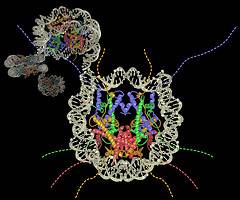
Scientists at Penn State have achieved a major milestone in the attempt to assemble, in a test tube, entire chromosomes from their component parts. The achievement reveals the process a cell uses to package the basic building blocks of an organism's entire genetic code - its genome. The evidence provided by early research with the new procedure overturns three previous theories of the genome-packaging process and opens the door to a new era of genome-wide biochemistry research.
Innovation - Chemistry - 17.05.2011
The World’s Smallest 3D Printer
[ Florian Aigner A research project at the Vienna University of Technology (TU Vienna) could turn futuristic 3D-printers into affordable everyday items. Printers which can produce three-dimensional objects have been available for years. However, at the Vienna University of Technology, a printing device has now been developed, which is much smaller, lighter and cheaper than ordinary 3D-printers.
Chemistry - Physics - 02.05.2011
U-M researchers working toward efficient harvesting of solar energy
ANN ARBOR, Mich.—At the University of Michigan College of Engineering, recent breakthroughs may lead to more effective means for harnessing the power of the sun. Conventional means of collecting solar energy, solar cells for example, have been notoriously inefficient. Now a team of chemical engineers at U-M is exploring new means of exploiting the abundant energy produced by Earth's nearest star.
Physics - Chemistry - 01.05.2011
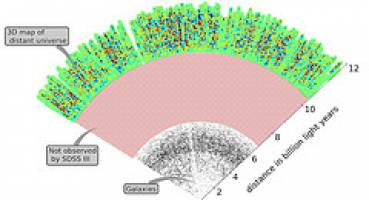
Scientists from the Sloan Digital Sky Survey (SDSS-III) collaboration, including an astronomer at Penn State, have created the largest-ever three-dimensional map of the distant universe by using the light of the brightest objects in the cosmos to illuminate ghostly clouds of intergalactic hydrogen. The map provides an unprecedented view of how the universe looked 10 billion years ago.
Physics - Chemistry - 29.04.2011
Empty Space in Jammed Materials Explains Exotic Universal Structural Features
Salvatore Torquato , a professor in the Department of Chemistry and the Princeton Institute for the Science and Technology of Materials at Princeton University, in collaboration with a team of researchers has uncovered universal features in the structures of jammed materials, suggesting a unified method to analyze disparate systems.
Health - Chemistry - 29.04.2011
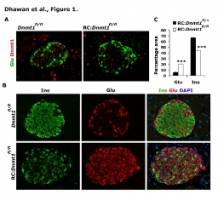
Simply put, people develop diabetes because they don't have enough pancreatic beta cells to produce the insulin necessary to regulate their blood sugar levels. But what if other cells in the body could be coaxed into becoming pancreatic beta cells? Could we potentially cure diabetes? Researchers from UCLA's Larry L. Hillblom Islet Research Center have taken an important step in that direction.
Physics - Chemistry - 22.04.2011
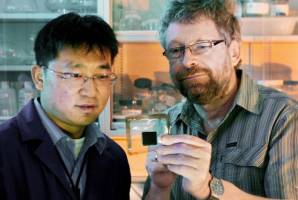
Laboratory scientists have developed a way to avoid the use of expensive platinum in hydrogen fuel cells. Los Alamos scientists document utility of non-precious-metal catalysts LOS ALAMOS, New Mexico, April 22, 2011—Los Alamos National Laboratory scientists have developed a way to avoid the use of expensive platinum in hydrogen fuel cells, the environmentally friendly devices that might replace current power sources in everything from personal data devices to automobiles.
Chemistry - Physics - 21.04.2011
A material heals itself
Imagine: Your 6-year-old found a nail in the garage and drew pictures across the side of your new car.
Chemistry - Health - 20.04.2011
CHAMPAIGN, lll. A new study in fruit flies offers a broad view of the potent and sometimes devastating molecular events that occur throughout the body as a result of methamphetamine exposure. The study, described in the journal PLoS ONE, tracks changes in the expression of genes and proteins in fruit flies ( Drosophila melanogaster ) exposed to meth.
Chemistry - Life Sciences - 12.04.2011

An international group of scientists has used a powerful new X-ray technique to observe for the first time at the molecular scale how muscle proteins change form and structure inside a contracting muscle cell. The study, led by scientists from King's College London, Università di Firenze (Italy), and the European Synchrotron Radiation Facility (ESRF) in Grenoble (France), is published in the latest issue of the Proceedings of the National Academy of Sciences (PNAS).
Life Sciences - Chemistry - 11.04.2011
Researchers Resurrect Ancient Enzymes to Reveal Conditions of Early Life on Earth
Scientists from Columbia University, Georgia Institute of Technology and the University of Granada have for the first time reconstructed active enzymes from four-billion-year-old extinct organisms. By measuring the properties of these enzymes, they can examine the conditions in which the extinct organisms lived.
Chemistry - 11.04.2011

Solar cells made from organic materials are inexpensive, lightweight and flexible, but their performance lags behind cells that contain silicon or other inorganic materials. Cornell chemist William Dichtel and colleagues have found a way to synthesize ordered organic films that could be a major step toward solving this problem.
Life Sciences - Chemistry - 07.04.2011

Scientists from the Universities of Birmingham and Bristol have discovered how marine bacteria join together two antibiotics they make independently to produce a potent chemical that can kill drug-resistant strains of the MRSA superbug. Working with Japanese pharmaceutical company Daiichi-Sankyo, and funded by the UK Biotechnology and Biological Sciences Research Council (BBSRC), the researchers' work paves the way for the creation of new hybrid antibiotics that may help to solve the growing problem of bacterial infections that are resistant to essentially all antibiotics.
Life Sciences - Chemistry - 06.04.2011

A Stanford research team uses glowing nanopillars to give biologists, neurologists and other researchers a deeper, more precise look into living cells. BY ANDREW MYERS As words go, evanescent doesn't see enough use. It is an artful term whose beauty belies its true meaning: fleeting or dying out quickly.
Life Sciences - Chemistry - 05.04.2011
Fruit Fly’s Response to Starvation Could Help Control Human Appetites
Biologists at UC San Diego have identified the molecular mechanisms triggered by starvation in fruit flies that enhance the nervous system's response to smell, allowing these insects and presumably vertebrates'including humans?to become more efficient and voracious foragers when hungry. Their discovery of the neural changes that control odor-driven food searches in flies, which they detail in a paper in the April 1 issue of the journal Cell, could provide a new way to potentially regulate human appetite.
Chemistry - 02.04.2011
Missing copy of Davy’s first book found at UCL
An extremely rare copy of the very first book written by Humphry Davy, one of the world's greatest scientists, at just 19 years of age, has been discovered in UCL's library collections. Essays on heat, light and the combinations of light was published in 1799, a youthful work that Davy was later in life embarrassed about having written.
Chemistry - 01.04.2011
Missing copy of Davy’s first book found at UCL
An extremely rare copy of the very first book written by Humphry Davy, one of the world's greatest scientists, at just 19 years of age, has been discovered in UCL's library collections. Essays on heat, light and the combinations of light was published in 1799, a youthful work that Davy was later in life embarrassed about having written.
Chemistry - Life Sciences - 01.04.2011
Did clay mould life’s origins?
Science Cath Harris | 01 Apr 11 An Oxford University scientist has taken our understanding of the origin of life a step further. Professor Don Fraser from the Department of Earth Sciences has carried out neutron scattering experiments to try to find out more about the role of geochemistry in determining the origin of our amino acids - key building blocks of life on Earth - and specifically why the DNA-coded amino acids that make up our proteins are all left-handed.
Chemistry - Life Sciences - 31.03.2011
Did clay mould life’s origins?
Science Cath Harris | 01 Apr 11 An Oxford University scientist has taken our understanding of the origin of life a step further. Professor Don Fraser from the Department of Earth Sciences has carried out neutron scattering experiments to try to find out more about the role of geochemistry in determining the origin of our amino acids - key building blocks of life on Earth - and specifically why the DNA-coded amino acids that make up our proteins are all left-handed.
Physics - Chemistry - 31.03.2011
Quantum mapmakers complete first voyage through spin liquid
Scientists from Oxford University have mapped a state of matter called 'quantum spin liquid', whose existence was proposed in the 1970s but which has only been observed recently. Until now there has been very limited information describing the physical characteristics of a quantum spin liquid state, but researchers from Oxford University's Department of Physics working with the Rutherford Appleton Laboratory have demonstrated the effect of temperature and magnetic field on this state of matter.


Chemistry - Mar 19
Leipzig University and Center for the Transformation of Chemistry conclude collaboration agreement
Leipzig University and Center for the Transformation of Chemistry conclude collaboration agreement
Chemistry - Feb 2
New material for use in the chemical industry capable of transforming CO2 into high value-added compounds
New material for use in the chemical industry capable of transforming CO2 into high value-added compounds
Chemistry - Feb 2
Material for modulating metal-organic frameworks for use in the chemical industry capable of transforming CO2 into high value-added compounds
Material for modulating metal-organic frameworks for use in the chemical industry capable of transforming CO2 into high value-added compounds
Chemistry - Jan 15
University of Glasgow spin-out hails milestone breakthrough in hydrogen energy process
University of Glasgow spin-out hails milestone breakthrough in hydrogen energy process
Life Sciences - Dec 17
Manchester Institute of Biotechnology welcomes three new professors, driving innovation in chemical and biological sciences
Manchester Institute of Biotechnology welcomes three new professors, driving innovation in chemical and biological sciences
Health - Nov 21
New Collaborative Research Centres: A Resounding Success for the University and the University Hospital
New Collaborative Research Centres: A Resounding Success for the University and the University Hospital
Chemistry - Nov 6
The scientific community and industry are seeking ways to accelerate the application of perovskite solar cells
The scientific community and industry are seeking ways to accelerate the application of perovskite solar cells