



Life Sciences - Mar 27
Understanding the Brain - TU Ilmenau's EU EMBRACE Project Nominated for European Excellence Award
Understanding the Brain - TU Ilmenau's EU EMBRACE Project Nominated for European Excellence Award
Social Sciences - Mar 27
A manual addresses, for the first time in Spain, child and adolescent sexual exploitation
A manual addresses, for the first time in Spain, child and adolescent sexual exploitation


Environment - Mar 26
Changing vegetation in thawing permafrost increases emissions of greenhouse gases
Changing vegetation in thawing permafrost increases emissions of greenhouse gases
Environment - Mar 26
University of Manchester hits major sustainability milestone, with Main Campus becoming 100% 'Zero Landfill'
University of Manchester hits major sustainability milestone, with Main Campus becoming 100% 'Zero Landfill'
Social Sciences - Mar 26
"It would be naive to believe that a social media ban will solve all problems"
"It would be naive to believe that a social media ban will solve all problems"


Health - Mar 26
Earlier detection, better outcomes: Irish researchers target rising bowel cancer rates with new blood test
Earlier detection, better outcomes: Irish researchers target rising bowel cancer rates with new blood test

Environment - Mar 26
UK must improve energy efficiency to end 50 years of policy failure and prevent future energy crises, study argues
UK must improve energy efficiency to end 50 years of policy failure and prevent future energy crises, study argues
Mathematics - Mar 26
From Materials to Medical Imaging, Fonseca's Work Shapes the Future of Innovation
From Materials to Medical Imaging, Fonseca's Work Shapes the Future of Innovation

news
Chemistry
Results 2601 - 2620 of 3958.
Chemistry - Physics - 05.10.2016
UChicago site of radiocarbon dating discovery named historic landmark
Among the artifacts from the University of Chicago's Oriental Institute that Prof. Willard Libby tested during the radiocarbon dating development process was this wood from an ancient Egyptian coffin. The artifact, more than 2,000 years old, dates to the Egyptian Ptolemaic period. OI founder James Henry Breasted purchased the artifact, and many others, during his honeymoon trip to Egypt in 1894-95.
Chemistry - Physics - 03.10.2016
Going beyond gold?
Experts from Cardiff University have proposed a much cheaper and more efficient way of producing a promising new catalyst that is used in reactions to produce a whole host of everyday materials, from electronics and cosmetics to sanitisation and pharmaceuticals. The team, from the Cardiff Catalysis Institute, have devised a new way of creating the catalyst graphitic oxide - a compound that is a pre-cursor to the 'wonder material' graphene - and shown how this can be effectively used in reactions to produce a widely used material called epoxide.
Physics - Chemistry - 29.09.2016
Microscope developed at MBL tracks individual molecules in living cells
Scientists at the Marine Biological Laboratory and colleagues have unveiled a new microscope that can track the position and orientation of individual molecules in living cells?nanoscale measurements that until now have posed a significant challenge. As reported this week in the Proceedings of National Academy of Sciences , the team's 'instantaneous fluorescence polarization' microscope offers new insights into how cells achieve directed functions or forces.
Chemistry - Physics - 27.09.2016
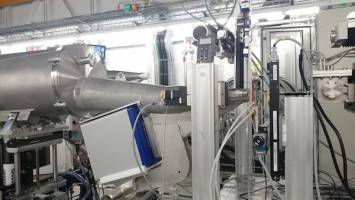
The PSI synchrotron radiation facility in Switzerland. To the left is the beamline that sends out the X-rays. The sample is attached to the small copper plate slightly to the right, and in the right-hand corner is the detector. PHOTO: Jenny Andersson Researchers at the Faculty of Science at Lund University in Sweden can now explain how the properties of the skin change depending on the environment.
Life Sciences - Chemistry - 27.09.2016
New imaging method developed for lipid with many functions
Fluorescence image of a HeLa cell in which the signaling lipid phosphatidic acid has been labeled with a green fluorescent dye using a new chemical tagging method developed by the Baskin Laboratory. Markers of two other cellular organelles, the endoplasmic reticulum and nucleus, are shown in red and blue, respectively.
Life Sciences - Chemistry - 26.09.2016
CRISPR toolbox expanded by protein that cuts RNA in two distinct ways
UC Berkeley biochemist Jennifer Doudna, molecular biologist Robert Tijan and a team of researchers have expanded the role of the newly discovered CRISPR protein C2c2 that targets RNA instead of DNA. C2c2 has been described as an RNA-guided RNA-cutting enzyme; however, a full understanding of how this protein acts to cleave RNA was lacking.
Health - Chemistry - 26.09.2016
315 from Sep 26, 2016 Molecular Stew Analysis produces WorldŽs first Description of Amyloid Intermediate Structures Scientists of Freie Universität and Max Planck Society succeed in worldŽs first structural analysis of aggregates believed to be cause of AlzheimerŽs disease
Scientists of Freie Universität and Max Planck Society succeed in worldŽs first structural analysis of aggregates believed to be cause of AlzheimerŽs disease ' 315/2016 from Sep 26, 2016 Scientists of Freie Universität Berlin und the Fritz Haber Institute of the Max Planck Society made a major step forward in analyzing the biochemical causes of AlzheimerŽs and ParkinsonŽs disease.
Health - Chemistry - 26.09.2016
Molecular Stew Analysis Produces WorldŽs First Description of Amyloid Intermediate Structures
Scientists of Freie Universität and Max Planck Society succeed in worldŽs first structural analysis of aggregates believed to be cause of AlzheimerŽs disease ' 315/2016 from Sep 26, 2016 Scientists of Freie Universität Berlin und the Fritz Haber Institute of the Max Planck Society made a major step forward in analyzing the biochemical causes of AlzheimerŽs and ParkinsonŽs disease.
Physics - Chemistry - 23.09.2016

Researchers have created an exotic 3-D racetrack for electrons in ultrathin slices of a nanomaterial they fabricated at the Department of Energy's Lawrence Berkeley National Laboratory (Berkeley Lab). The international team of scientists from Berkeley Lab, UC Berkeley, and Germany observed, for the first time, a unique behavior in which electrons rotate around one surface, then through the bulk of the material to its opposite surface and back.
Chemistry - 22.09.2016
Tracking down the origin of mercury contamination in human hair
Mercury is a potent neurotoxin present in our daily lives and our body can accumulate it over the years.
Life Sciences - Chemistry - 22.09.2016
RNA, gravitational waves focus of two new grants
UNIVERSITY PARK, Pa. Four Penn State researchers have been awarded a total of $450,000 by the CharlesE. Kaufman Foundation to carry out basic science research over the next two years. Paul Babitzke , professor of biochemistry and molecular biology ; Sarah Assmann , Waller Professor of Biology ; and Philip Bevilacqua , professor of chemistry , have received a $300,000 New Initiatives grant from the Foundation to study RNA and the processes it regulates.
Environment - Chemistry - 21.09.2016
UW team to study baby teeth in effort to identify autism risk factors
University of Washington researchers are part of a national team that will study the baby teeth of children who have siblings with autism to determine if prenatal exposure to chemicals increases their risk of developing the disorder. The study will involve testing children's teeth for levels of environmental chemicals that they might have been exposed to in the womb, a critical time for neurodevelopment.
Life Sciences - Chemistry - 21.09.2016
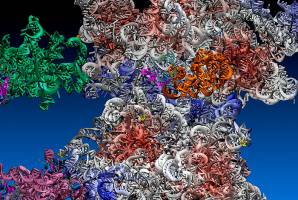
A special stretch of ribonucleic acid (RNA) called COOLAIR is revealing its inner structure and function to scientists, displaying a striking resemblance to an RNA molecular machine. Los Alamos-U.K. collaboration unveils hidden molecular machinery in RNA processes LOS ALAMOS, N.M. Sept.
Chemistry - Physics - 20.09.2016
New findings by Stanford chemists could lead to greener methanol production
The results could pave the way to the cleaner production of methanol, an important industrial feedstock and potential green fuel. A team led by chemists at Stanford University has unraveled a longstanding mystery that brings them one step closer to a cleaner, more energy-efficient way to make methanol, an important industrial chemical used in products such as paints, plastics and glues.
Physics - Chemistry - 19.09.2016
Nanoscale Tetrapods Could Provide Early Warning of a Material’s Failure
These atom-scale computer simulations of tetrapods show how they sense compression (left) and tension along one axis (right), both of which are crucial to detecting nanoscale crack formation. The color bar indicates the percent change of the tetrapods' volume.
Earth Sciences - Chemistry - 16.09.2016
Earthquakes, Marsquakes,? and the possibility of life
A new study shows that rocks formed by the grinding together of other rocks during earthquakes are rich in trapped hydrogen - a finding that suggests similar seismic activity on Mars may produce enough hydrogen to support life. Researchers from Yale, the University of Aberdeen, and Brock University studied rock formations around active fault lines in the Outer Hebrides, off the coast of Scotland.
Chemistry - Physics - 15.09.2016
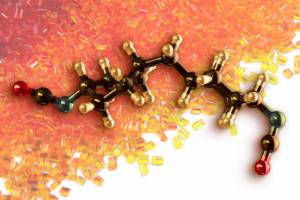
All polymers have a distinctive degree of elasticity - how much they will stretch when a force is applied. However, for the past 100 years, polymer scientists have been stymied in their efforts to predict polymers? elasticity, because the materials usually have structural flaws at the molecular level that impact elasticity in unknown ways.
Health - Chemistry - 14.09.2016
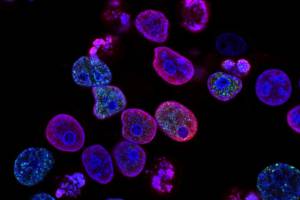
Nanoparticles offer a promising way to deliver cancer drugs in a targeted fashion, helping to kill tumors while sparing healthy tissue. However, most nanoparticles that have been developed so far are limited to carrying only one or two drugs. MIT chemists have now shown that they can package three or more drugs into a novel type of nanoparticle, allowing them to design custom combination therapies for cancer.
Physics - Chemistry - 13.09.2016
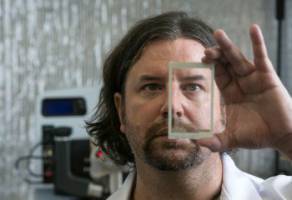
Sussex physicists develop new touchscreen technology Physicists at the University of Sussex are at an advanced stage of developing alternative touchscreen technology to overcome the shortfall in the traditional display, phone and tablet material that relies on electrodes made from indium tin oxide (ITO).
Chemistry - Life Sciences - 12.09.2016

Experiments performed by ETH scientists have shown that it is remarkably easy for protein-like, two-dimensional structures - amyloids - to form from basic building blocks. This discovery supports the researchers? hypothesis that primal life could have evolved from amyloids such as these. The story starts at least four billion years ago, when there was no living matter on the planet.


Life Sciences - Mar 27
Understanding the Brain - TU Ilmenau's EU EMBRACE Project Nominated for European Excellence Award
Understanding the Brain - TU Ilmenau's EU EMBRACE Project Nominated for European Excellence Award
Social Sciences - Mar 27
A manual addresses, for the first time in Spain, child and adolescent sexual exploitation
A manual addresses, for the first time in Spain, child and adolescent sexual exploitation
Environment - Mar 26
Changing vegetation in thawing permafrost increases emissions of greenhouse gases
Changing vegetation in thawing permafrost increases emissions of greenhouse gases
Environment - Mar 26
University of Manchester hits major sustainability milestone, with Main Campus becoming 100% 'Zero Landfill'
University of Manchester hits major sustainability milestone, with Main Campus becoming 100% 'Zero Landfill'
Social Sciences - Mar 26
"It would be naive to believe that a social media ban will solve all problems"
"It would be naive to believe that a social media ban will solve all problems"
Health - Mar 26
Earlier detection, better outcomes: Irish researchers target rising bowel cancer rates with new blood test
Earlier detection, better outcomes: Irish researchers target rising bowel cancer rates with new blood test
Environment - Mar 26
UK must improve energy efficiency to end 50 years of policy failure and prevent future energy crises, study argues
UK must improve energy efficiency to end 50 years of policy failure and prevent future energy crises, study argues
Mathematics - Mar 26
From Materials to Medical Imaging, Fonseca's Work Shapes the Future of Innovation
From Materials to Medical Imaging, Fonseca's Work Shapes the Future of Innovation