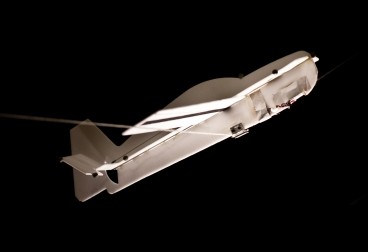
MIT researchers from the Computer Science and Artificial Intelligence Laboratory have developed a control system that lets a foam glider land on a perch like a pet parakeet.
Photo: Jason Dorfman/CSAIL
CAMBRIDGE, Mass. Everyone knows what it's like for an airplane to land: the slow maneuvering into an approach pattern, the long descent, and the brakes slamming on as soon as the plane touches down, which seems to just barely bring it to a rest a mile later. Birds, however, can switch from barreling forward at full speed to lightly touching down on a target as narrow as a telephone wire. Why can't an airplane be more like a bird' MIT researchers have demonstrated a new control system that allows a foam glider with only a single motor on its tail to land on a perch, just like a pet parakeet. The work could have important implications for the design of robotic planes, greatly improving their maneuverability and potentially allowing them to recharge their batteries simply by alighting on power lines. Birds can land so precisely because they take advantage of a complicated aerodynamic phenomenon called 'stall,' a natural brake that lets them stop quickly within short distances. When a commercial airplane is in flight, its wings are either parallel to the ground or, when it's changing altitude or banking, a few degrees off.
TO READ THIS ARTICLE, CREATE YOUR ACCOUNT
And extend your reading, free of charge and with no commitment.