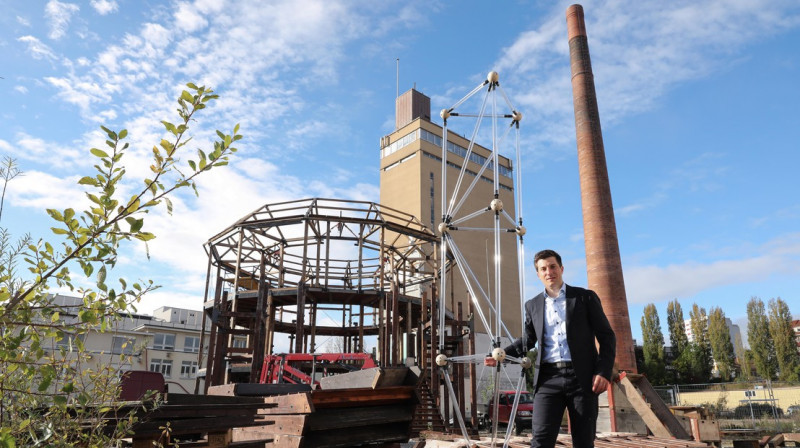
 Brütting's modular system assembled near the Smart Living Lab in Fribourg
Brütting's modular system assembled near the Smart Living Lab in Fribourg © 2020 EPFL - A new software developed at EPFL can help architects to design building structures that incorporate both new and reused components, thereby lowering their environmental impact. The construction industry is among the world's most polluting sectors: in developed countries it accounts for some 40% of CO
2 emissions. It consumes up to half of all resources and generates about a third of all waste. As a result, in order to comply with international treaties and the United Nations' Sustainable Development Goals, the industry is being forced to take bold steps to reduce its environmental footprint. "We need to mitigate this impact as quickly as possible," says Jan Brütting, who has just completed a PhD at EPFL's Structural Xploration Lab (SXL), headed by Corentin Fivet from the Smart Living Lab in Fribourg. "One way to achieve this is by systematically implementing the principles of the circular economy." When designing a building, instead of using new components or even recycling existing metal parts by melting them down and casting them into new shapes, Brütting encourages companies, structural engineers and architects to base their designs on previously-used components, without reprocessing them. This makes sense, since the reliability and technical properties of these components have already been proven. "It means we need to change everything we've learned up to now," he notes.
TO READ THIS ARTICLE, CREATE YOUR ACCOUNT
And extend your reading, free of charge and with no commitment.
Your Benefits
- Access to all content
- Receive newsmails for news and jobs
- Post ads