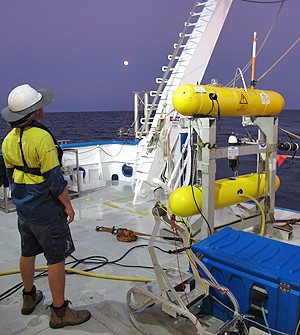
The aquatic robot was developed by University of Sydney experts.
The watery depths of Western Australia's Ningaloo coast will be audited by marine engineers and scientists this week using an aquatic robot and technology developed by University of Sydney mechatronic experts. The innovative technology will assist scientists from the Australian Institute of Marine Science (AIMS) in detailed mapping of the seabed communities of Ningaloo Reef's deeper waters, which form part of Australia's Integrated Marine Observing System (IMOS). An Autonomous Underwater Vehicle (AUV) will take up to 50,000 images in a day with its high resolution cameras and will also collect detailed multi-beam sonar and water-column measurements while underway. Nicknamed "Sirius", the AUV will dive to depths of 200m to conduct surveys and gather data on the complex ocean environs. Sirius is capable of creating detailed three dimensional models of the seafloor by using software systems and algorithms developed by robotics engineers at the University of Sydney's Australian Centre for Field Robotics (ACFR). Sirius initially surveyed the world heritage listed area at Ningaloo five years ago. The data collected will provide scientists with unparalleled information on how our deep-sea communities may have been distributed, damaged or altered over time.
TO READ THIS ARTICLE, CREATE YOUR ACCOUNT
And extend your reading, free of charge and with no commitment.