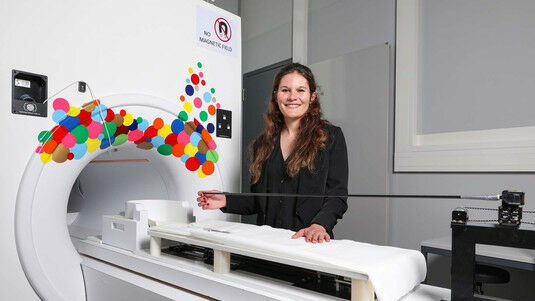
© 2021 EPFL / Alain Herzog Scientists are developing a completely new "brain stress test" for evaluating the mental status of patients with Parkinson's disease, the second most prevalent neurodegenerative disease worldwide. It involves awakening the "ghosts" hidden in specific networks of the brain to predict the onset of hallucinations. "We're developing something similar to a cardiac stress test, but instead of testing the heart, we're testing the brain," says EPFL neuroscientist Olaf Blanke. EPFL scientists are providing a new way to evaluate the onset of hallucinations in patients with Parkinson's disease with the help of a newly developed brain stress test, focusing their research on presence hallucinations. They also provide evidence of a promising biomarker for predicting the severity of the disease's progression. The results of their three-tier study, involving 56 patients affected by the disease and recruited at several centers in Switzerland and Spain, are published in today's edition of Science Translational Medicine (STM). "An important challenge with hallucinations is that they occur spontaneously, that their occurrence cannot be predicted, that many patients may not openly report them, possibly out of fear, and that it is currently very challenging for physicians to quantify their occurrence, phenomenology and intensity," continues Fosco Bernasconi, co-first author of the paper.
TO READ THIS ARTICLE, CREATE YOUR ACCOUNT
And extend your reading, free of charge and with no commitment.
Your Benefits
- Access to all content
- Receive newsmails for news and jobs
- Post ads