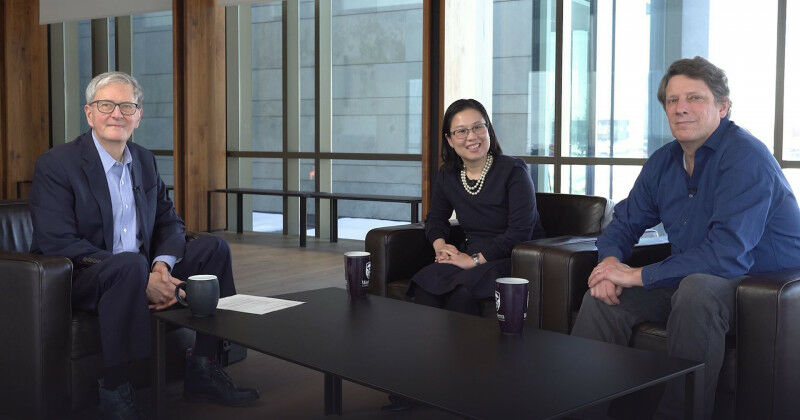
(From left) Western President Alan Shepard, professors Kate Choi, director, Centre for Research on Social Inequality and Eric Arts, executive director, Imaging Pathogens for Knowledge Translation Facility. (Steven Anderson/Western Communications)
( From left ) Western President Alan Shepard, professors Kate Choi, director, Centre for Research on Social Inequality and Eric Arts, executive director, Imaging Pathogens for Knowledge Translation Facility. (Steven Anderson/Western Communications) President Alan Shepard in conversation with professors Kate Choi and Eric Arts on the social determinants of COVID-19 Three years after COVID-19 was declared a pandemic, the World Health Organization has warned the next pandemic could be caused by even deadlier pathogens. Researchers are examining the virus's ongoing impact on public health and society. President Alan Shepard recently sat down with Professor Kate Choi, director, Centre for Research on Social Inequality and Professor Eric Arts, executive director, Imaging Pathogens for Knowledge Translation Facility , for a four-part video series that includes a wide-ranging discussion - from how the pandemic has re-oriented their research, to data collection in Canada; and from the nature of long COVID, to health-care inequities and vaccine skepticism. The conversation has been edited for clarity and length. Alan Shepard: How has your research changed in the course of the pandemic? What were you doing right before it hit? Kate Choi: Before the pandemic, I was studying inequality across families, particularly racial and socio-economic inequalities and how that affects the health of children. After the pandemic started, a lot of countries were seeing a pattern of racial and ethnic inequalities in COVID-19 rates.
TO READ THIS ARTICLE, CREATE YOUR ACCOUNT
And extend your reading, free of charge and with no commitment.