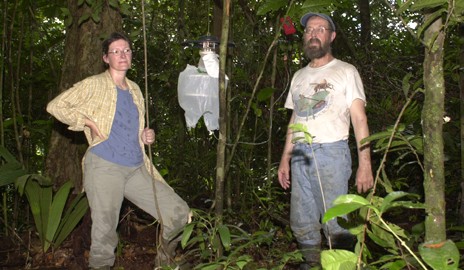
Leonard Munstermann (right) and Lorenza Beati, a former research scientist in his lab, use an LED-modified trap to catch sand flies during field research in French Guiana.
Fieldwork in Peru's Andes Mountains is demanding, especially when it involves hauling heavy equipment to remote sites that are accessible only by traversing the region's rugged terrain. But the task of collecting insects for the study of vector-borne diseases and other purposes has become a little less onerous since a Yale School of Public Health researcher and colleagues designed a lighter - and perhaps better - trap. The updated device incorporates modern lighting technology in the form of light emitting diodes (LEDs) that offer researchers conducting fieldwork some distinct advantages over previous light-based designs. The new trap is substantially lighter and more durable and runs far longer in isolated areas where fresh batteries will likely be hard to come by. LEDs also may be more effective at luring the insects that researchers want to study. This is because LEDs offer much more flexibility in the wavelength of light emitted than conventional incandescent or fluorescent forms of lighting. With an LED, a specific range of light, down to a few nanometers of the electromagnetic spectrum, can be selected.
TO READ THIS ARTICLE, CREATE YOUR ACCOUNT
And extend your reading, free of charge and with no commitment.