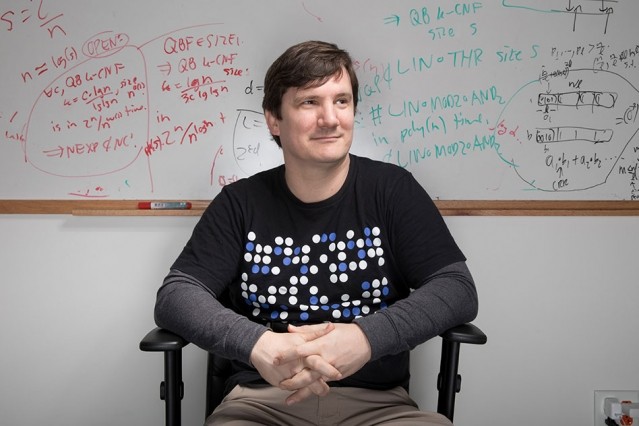
Ryan Williams, having joined the MIT electrical engineering and computer science faculty with tenure this year, hasn’t solved the problem of P vs. NP - nobody has - however, he’s made one of the most important recent contributions toward its solution.
In his junior year of high school, Ryan Williams transferred from the public school in his hometown of Florette, Alabama - "essentially a courthouse and a couple gas stations," as he describes it - to the Alabama School of Math and Science in Mobile. Although he had been writing computer programs since age 7 - often without the benefit of a computer to run them on - Williams had never taken a computer science class. Now that he was finally enrolled in one, he found it boring, and he was not shy about saying so in class. Eventually, his frustrated teacher pulled a heavy white book off of a shelf, dumped it dramatically on Williams's desk, and told him to look up the problem described in the final chapter. "If you can solve that," he said, "then you can complain." The book was "Introduction to Algorithms," co-written by MIT computer scientists Charles Leiserson and Ron Rivest and one of their students, and the problem at the back was the question of P vs. NP , which is frequently described as the most important outstanding problem in theoretical computer science. Twenty-two years later, having joined the MIT electrical engineering and computer science faculty with tenure this year, Williams is now a colleague of both Leiserson and Rivest, in the Theory of Computing Group at MIT's Computer Science and Artificial Intelligence Laboratory.
TO READ THIS ARTICLE, CREATE YOUR ACCOUNT
And extend your reading, free of charge and with no commitment.