


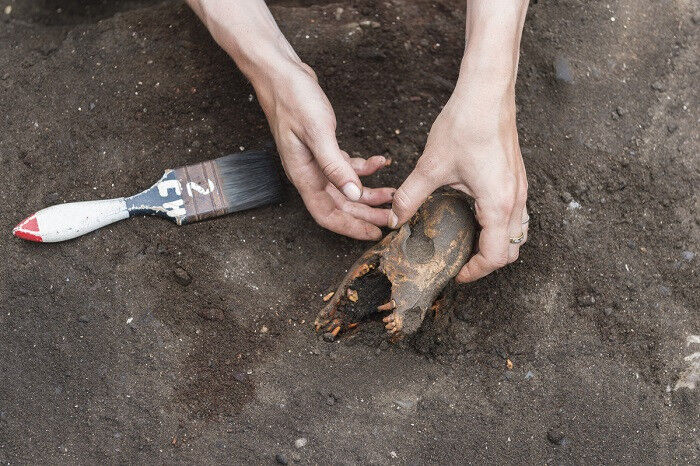
These results, which emerged from research conducted by an international team led by scientists from the CNRS, MNHN, IRD, and Université de Rennes 1 , were recently published in the journal Proceedings of Biology . They reflect changes to the way of life of ancient populations, as well as the upheaval wrought by colonial history.
They were achieved by combining archaeological and genetic data in order to establish an initial chronology for the dispersal of dogs on the continent.
Read the CNRS Le Journal article on "How the dog re-discovered America" https://lejournal.cnrs.fr/articles/comment-le-chien-a-redecouvert-lamerique
1 Working at the Archaeology of the Americas Laboratory (CNRS / Université Panthéon-Sorbonne), the Bioarchaeology and Environment-Society Interactions Laboratory (CNRS / MNHN), the Centre for Research on Biodiversity and the Environment (CNRS / IRD / Tou-louse INP / Université de Toulouse), the Institute of Genetics and Development of Rennes (CNRS / Université de Rennes / INSERM), and the Ecosystems, Biodiversity, and Evolution Laboratory (CNRS / Université de Rennes)
Ancient dog mitogenomes support the dual dispersal of dogs and agriculture into South America.
Manin, A et al . 18/06/2025, Proc. R. Soc. B 292: 20242443.DOI : https://doi.org/10.1098/rspb.2024.2443


