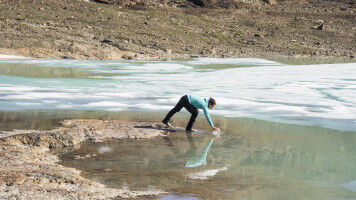
The Pacific Northwest is home to tens of thousands of seldom-seen mountain wetlands. Maureen Ryan/University of Washington
Far above the wildfires raging in Washington's forests, a less noticeable consequence of this dry year is taking place in mountain ponds. The minimal snowpack and long summer drought that have left the Pacific Northwest lowlands parched have also affected the region's amphibians through loss of mountain pond habitat. According to a new paper published Sept. 2 in the open-access journal PLOS ONE, this summer's severe conditions may be the new normal within just a few decades. "This year is an analog for the 2070s in terms of the conditions of the ponds in response to climate,” said Se-Yeun Lee , research scientist at University of Washington's Climate Impacts Group and one of the lead authors of the study. Current conditions provide a preview of how that will play out. "We've seen that the lack of winter snowpack and high summer temperatures have resulted in massive breeding failures and the death of some adult frogs,” said co-author Wendy Palen , an associate professor at Canada's Simon Fraser University who has for many years studied mountain amphibians in the Pacific Northwest.
TO READ THIS ARTICLE, CREATE YOUR ACCOUNT
And extend your reading, free of charge and with no commitment.