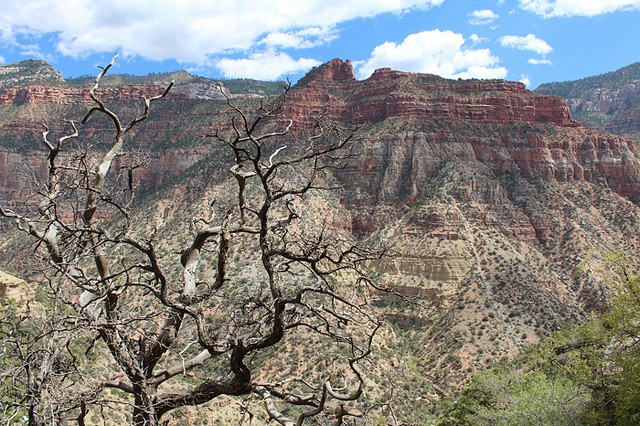
A dead pinon at the edge of the Grand Canyon, harbinger of the future for trees in the Southwest United States. Photo courtesy A. Park Williams.
A team of scientists concluded that in the warmer and drier Southwest of the near future, widespread tree mortality will cause forest and species distributions to change substantially. "There will still be wet winters, but they will more often be followed by warm summers, putting stress on trees and limiting their ability to respond to a subsequent wet winter," Williams said. Southwestern US trees face rising drought stress and mortality as climate warms. LOS ALAMOS, N.M. Oct. 1, 2012—Combine the tree-ring growth record with historic information, climate records and computer-model projections of future climate trends, and you get a grim picture for the future of trees in the southwestern United States. That's the word from a team of scientists from Los Alamos National Laboratory, the U.S. Geological Survey, University of Arizona, and several other partner organizations. Described in a paper published in Nature Climate Change this week, "Temperature as a potent driver of regional forest drought stress and tree mortality,” the team concluded that in the warmer and drier Southwest of the near future, widespread tree mortality will cause forest and species distributions to change substantially.
TO READ THIS ARTICLE, CREATE YOUR ACCOUNT
And extend your reading, free of charge and with no commitment.