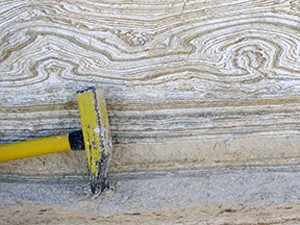
A section of exposed sediments along the shoreline of the Dead Sea exposes layers set down in wet and dry seasons when the lake was much higher. The crumpled zone represents disruptions from earthquakes. (Photo: Adi Torfstein)
University of Minnesota professor is part of international team that predicts the volatile region's water may once again vanish. MINNEAPOLIS / ST. PAUL (12/05/2011) —An international team of scientists drilling deep under the bed of the Dead Sea has found evidence that the sea may have dried up during a past warm period similar to predicted scenarios for climate change in coming decades. Emi Ito, professor of earth sciences in the University of Minnesota's College of Science and Engineering, is a research team member. With nations in the volatile region already running short on water, the finding could be a warning of worse shortages to come, the researchers said. The lakebed cores, which contain about 200,000 years of environmental history—the Mideast's longest archive—also record earthquakes and other natural phenomena, and may shed light on human development and current seismic risks. The preliminary results were presented today at the American Geophysical Union's fall meeting in San Francisco. Spanning Israel and Jordan, the Dead Sea is the world's lowest-lying place on land, with shores some 1,400 feet below sea level and salty waters going down another 1,200 feet.
TO READ THIS ARTICLE, CREATE YOUR ACCOUNT
And extend your reading, free of charge and with no commitment.