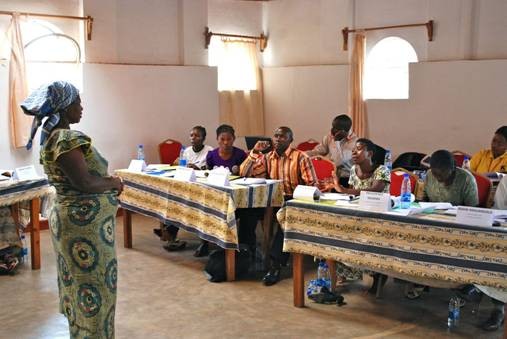
Debra Kaysen A therapist leads a training class for Congolese psychosocial workers.
Posted under: Health and Medicine , Research , Social Science , UW and the Community. Survivors of sexual violence have long gone without treatment and suffered debilitating symptoms of depression, anxiety and post-traumatic stress disorder. But a randomized controlled study of 405 rape survivors in eastern Democratic Republic of Congo proves that short-term therapy delivered by paraprofessionals is effective at reducing mental health symptoms, according to a study released June 6 in the New England Journal of Medicine . The study, "Controlled Trial of Psychotherapy for Congolese Survivors of Sexual Violence,” provided 154 women with cognitive processing therapy (1 individual session and 11 group sessions) and 248 women with individual supportive counseling. The therapy was conducted between April and July in 2011 by Johns Hopkins University and University of Washington researchers working with the International Rescue Committee and local psychosocial workers. Six months after treatment, just 9 percent of women in the therapy group met criteria for probable depression and anxiety, compared to 42 percent of women in the individual-support group, according to the study. "We saw women, who once felt too stigmatized to be part of their community, re-engage after receiving cognitive processing therapy,” said Judith K. Bass, lead author of the study and assistant professor with the Department of Mental Health at Johns Hopkins Bloomberg School.
TO READ THIS ARTICLE, CREATE YOUR ACCOUNT
And extend your reading, free of charge and with no commitment.