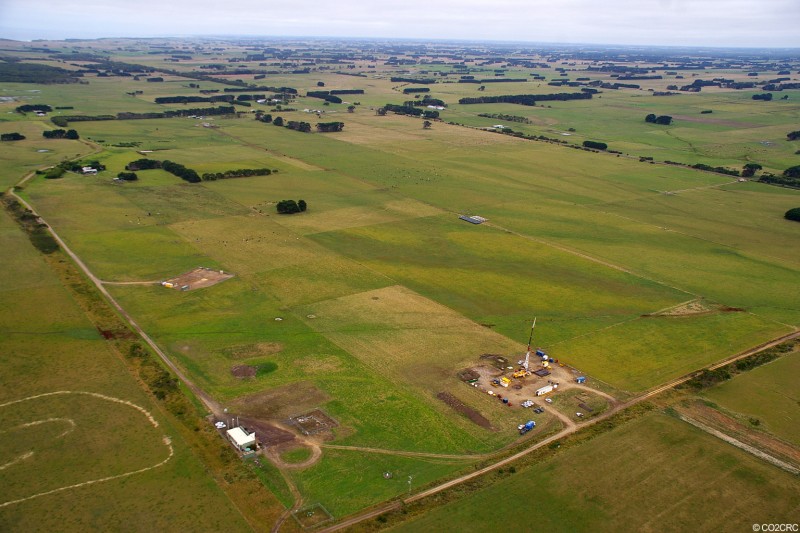
Aerial view of the Otway Project in Australia (Image: CO2CRC).
A demonstration project on the southeastern tip of Australia has helped to verify that depleted natural gas reservoirs can be repurposed for geologic carbon sequestration, which is a climate change mitigation strategy that involves pumping CO2 deep underground for permanent storage. The project, which includes scientists from Lawrence Berkeley National Laboratory (Berkeley Lab), also demonstrated that depleted gas fields have enough CO2 storage capacity to make a significant contribution to reducing global emissions. During an 18-month span beginning in April 2008, an international team of researchers injected 65,000 tonnes of CO2-rich gas two kilometers underground into a depleted gas field in western Victoria, Australia. That's about 130 tonnes of CO2 per day, or the amount emitted by a small, 10-megawatt power plant. It's also the daily CO2 emissions required to supply 6000 average U.S. homes with electricity. Extensive monitoring conducted during and after the injection found no measureable effect of stored CO2 on soil, groundwater, or the atmosphere. "There was no discernible leakage.
TO READ THIS ARTICLE, CREATE YOUR ACCOUNT
And extend your reading, free of charge and with no commitment.