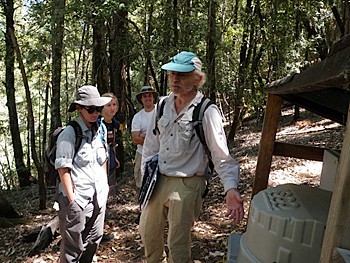
Bill Dietrich (in hat) with students at his Angelo Reserve hillside study site, dubbed Rivendell after the land of the elves in Lord of the Rings. Mary Power photo.
A segment of the Eel River as it flows through the Angelo Coast Range Reserve in northern California. Christopher Woodcock photo. University of California, Berkeley, scientists will receive $4,900,000 over the next five years to study the nearly 10,000 square kilometer Eel River watershed in Northern California and how its vegetation, geology and topography affect water flow all the way to the Pacific Ocean. What the researchers uncover will help improve global climate models and modeling tools that can be used by state or regional decision makers to guide planning. Their discoveries may eventually allow scientists to predict the impact of changing climate and land use on future droughts, floods and supplies of water for drinking and agriculture. Funded by the National Science Foundation, the Eel River Observatory is one of four new Critical Zone Observatories that received grants late last year, bringing the total number of such observatories to 10. All focus on the so-called "critical zone”: the thin veneer of Earth, from the bottom of the groundwater to the tree tops, that is critical to aquatic and terrestrial life as the source of fresh water and site of soil formation from rock.
TO READ THIS ARTICLE, CREATE YOUR ACCOUNT
And extend your reading, free of charge and with no commitment.