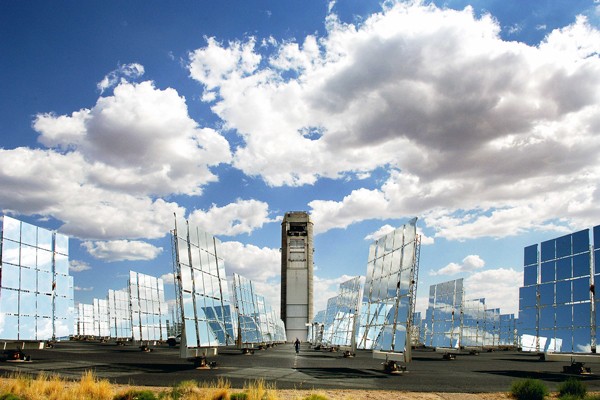
Engineers in Stanford’s Predictive Science Academic Alliance Program will embrace exascale computing while developing complex computer models of technologies that could increase the efficiency of solar concentrators, such as this one operated by the U.S. Department of Energy in New Mexico.
Associate Professor Gianluca Iaccarino will lead a government-funded project that will use the next generation of supercomputers to model techniques that could dramatically increase the efficiency of solar power. The project will receive $3.2 million per year for five years. Some mathematical simulations used to predict the outcomes of real events are so complex that they'll stump even today's top supercomputers. To incubate the next generation of supercomputers for tackling real-world problems, the National Nuclear Security Administration (NNSA) has selected Stanford as one of its three new Multidisciplinary Simulation Centers. The Stanford effort, under the leadership of Gianluca Iaccarino , an associate professor of Mechanical Engineering and the Institute for Computational Mathematical Engineering , will receive $3.2 million per year for the next five years under the NNSA's Predictive Science Academic Alliance Program II (PSAAP II). The University of Utah and the University of Illinois-Urbana-Champaign were selected to house the other two centers. Participants in PSAAP II will devise new computing paradigms within the context of solving a practical engineering problem.
TO READ THIS ARTICLE, CREATE YOUR ACCOUNT
And extend your reading, free of charge and with no commitment.