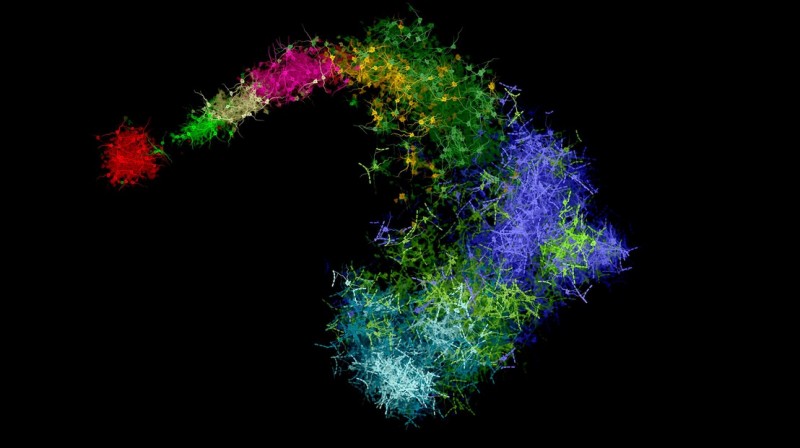
Data-based representation of molecular oligodendrocyte diversity in the central nervous system. Credit: Job van der Zwan (Karolinska Institute)
Continuing its investment in EPFL, the Chan Zuckerberg Initiative (CZI) has awarded a grant to the lab of Gioele La Manno , together with the Karolinska Institute and The University of Edinburgh. The collaborative research aims at new therapies for multiple sclerosis, and will be part of the Human Cell Atlas project. "I am very excited that the Chan Zuckerberg Initiative has sponsored this project under the umbrella of the new Seed Networks for the Human Cell Atlas program," says Gioele La Manno, who is also EPFL's first ELISIR Scholar. "We wanted to focus on the epigenetic state of oligodendrocyte-lineage cells, with the long-term aim of designing new therapies for inducing regeneration in multiple sclerosis." Oligodendrocytes are cells of the central nervous system. They produce fatty myelin sheaths around the long axons of neurons, supporting and insulating them, and protecting the neurons' communication pathways. The grant is awarded jointly with two other research groups, Gonçalo Castelo-Branco's at the Karolinska Institute (Sweden) and Anna Williams' at The University of Edinburgh (UK) . "I am thrilled to work together with such a fantastic combination of experts in biology, clinical science, and bioinformatics, all sharing an interest for neuroscience and oligodendrocytic cells," says La Manno.
TO READ THIS ARTICLE, CREATE YOUR ACCOUNT
And extend your reading, free of charge and with no commitment.