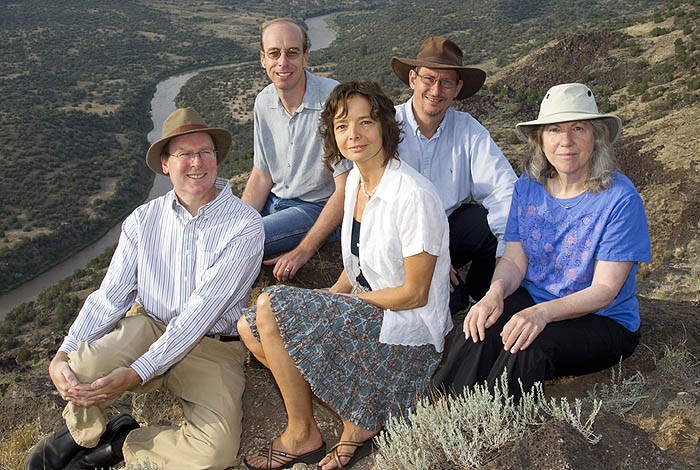
From left, Los Alamos scientists Joel Berendzen, Ben McMahon, Mira Dimitrijevic, Nick Hengartner and Judith Cohn
The Sequedex team was originally tasked with investigating DNA analysis on the Laboratory's Roadrunner supercomputer, but quickly realized that improvements in the algorithm made having so much hardware unnecessary. "They asked us to build a rocket ship," Berendzen said, "but instead we built a 10,000 mph motorcycle." - Evolutionary theory, web-search technology combine for DNA analysis. Bioinformatics breakthrough has clinical & environmental applications. LOS ALAMOS, NEW MEXICO, October 4, 2012—New software from Los Alamos National Laboratory called Sequedex uses evolutionary theory to swiftly identify short "reads” of DNA, calling out the specific organisms from which the DNA came and their likely activity. "Sequedex makes it possible for a researcher to analyze data hot off a DNA sequencer using a laptop,” said Joel Berendzen, a scientist on the project. "The tool characterizes whole communities of microorganisms such as those in the mouth in a matter of minutes. Sequedex works like a web search engine, making exact matches between DNA sequences and a list of "keywords” called phylogenetic signatures, then placing any hits on the appropriate branch of the Tree of Life.
TO READ THIS ARTICLE, CREATE YOUR ACCOUNT
And extend your reading, free of charge and with no commitment.