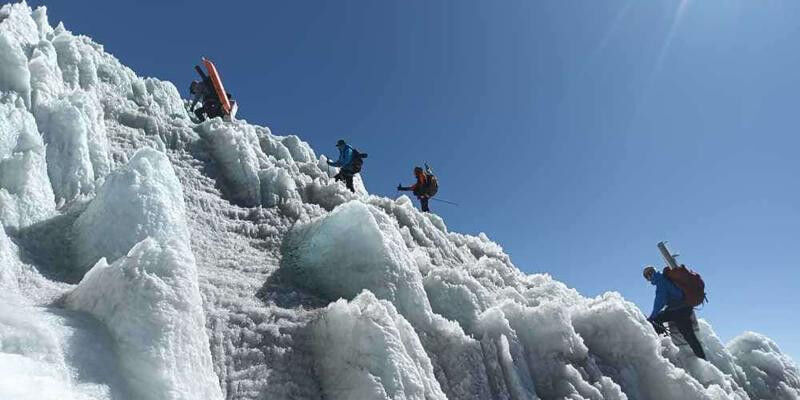
An international team, including scientists from the University of Fribourg, has succeeded in extracting two ice cores over 100 metres long from a glacier in Tajikistan. A real technical and logistical feat at an altitude of 5,800 metres. The two-week expedition, which began on September 24, aims to safeguard several millennia of climatic history.
Outside the poles, the Pamir is the planet’s most glaciated region. Their ice, formed over the centuries, tells the story of climate and its evolution, stratum by stratum. Scientists have set themselves the task of saving these exceptional archives before global warming irreversibly erases them. At present, the region’s glaciers are among the least documented on the planet
High-flying work
Until now, attempts to extract ice cores have been hampered by logistical and access problems. Thanks to the PAMIR project, funded by the Swiss Polar Institute, researchers have finally succeeded in overcoming these obstacles. Initially, working with Tajik institutions such as the Tajik Academy of Sciences, the scientists identified a promising site: the Kon Chukurbashi ice cap, located at an altitude of 5800 metres in the Murgha region. The researchers decided that this was a good place to take two cores, invaluable direct evidence of the region’s ancient atmospheres
Two exceptionally large cores
13 scientists then travelled to Tajikistan to turn this ambition into reality. Coordinated by the University of Fribourg and carried out in collaboration with the Tajik Academy of Sciences and universities in Switzerland, Austria, Japan and the USA, the expedition quickly achieved its objectives. our colleagues succeeded in extracting two cores, the first measuring 104.7 metres and the second 105 metres," enthuses Martin Hölzle, Professor in the Department of Geosciences at the University of Fribourg and the driving force behind the PAMIR project. It’s all the more remarkable that this is the first deep glacial archive at high altitude in the Pamir, at a time when such opportunities are becoming increasingly rare.’
For future generations
The first core will be analyzed as part of the research carried out by the PAMIR project. The second core will form part of the Ice Memory project, whose aim is to enable future generations of scientists to generate new knowledge after the glaciers have disappeared. To ensure perfect preservation, the sample will be stored in Antarctica at the French-Italian Concordia station. These samples will provide invaluable information for anticipating the future of our climate and informing the political decisions of future generations on a global scale.