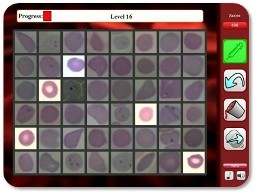
Sample game screen
Online crowd-sourcing — in which a task is presented to the public, who respond, for free, with various solutions and suggestions — has been used to evaluate potential consumer products, develop software algorithms and solve vexing research-and-development challenges. But diagnosing infectious diseases? Working on the assumption that large groups of public non-experts can be trained to recognize infectious diseases with the accuracy of trained pathologists, researchers from the UCLA Henry Samueli School of Engineering and Applied Science and the David Geffen School of Medicine at UCLA have created a crowd-sourced online gaming system in which players distinguish malaria-infected red blood cells from healthy ones by viewing digital images obtained from microscopes. The UCLA team found that a small group of non-experts playing the game (mostly undergraduate student volunteers) was collectively able to diagnosis malaria-infected red blood cells with an accuracy that was within 1.25 percent of the diagnostic decisions made by a trained medical professional. "The idea is, if you carefully combine the decisions of people — even non-experts — they become very competitive," said Aydogan Ozcan, an associate professor of electrical engineering and bioengineering and the corresponding author of the crowd-sourcing research. "Also, if you just look at one person's response, it may be OK, but that one person will inevitably make some mistakes.
TO READ THIS ARTICLE, CREATE YOUR ACCOUNT
And extend your reading, free of charge and with no commitment.