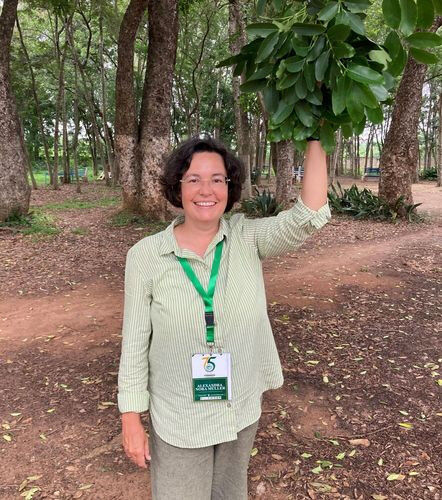
in the Amazon region and in Southeast Asia, reduced rainfall, deforestation and fires are already leading to a deterioration in forest quality and changes in ecosystems," says Alexandra Nora Müllner-Riehl from the Institute of Biology at Leipzig University. Müllner-Riehl is Professor of Molecular Evolution and Systematics of Plants. On the occasion of Tropical Forest Day on September 14, Müllner-Riehl answers questions about her current research. In the interview, she talks about the special feeling of standing in a tropical forest, biodiversity in the tropics and the problems facing tropical forests.
You do research on tropical forests - what was your last research project and what did you find out?
In one of our last research projects, together with my colleague Dr. Abubakar Bello, we looked at the plant biodiversity of Nigeria, the most populous country on the African continent. Evidence and data from herbaria, scientific plant collections, also known as "libraries of biodiversity", were of central importance for this work. We discovered that more than 1000 vascular plants could still be undescribed. This means that there will be an approximate increase of 20 percent in the number of recognized vascular plant species in this West African country over the next 50 years.
What current problems do you see in relation to tropical forests as a result of your research?
The most biodiverse regions of the world are home to a good proportion of the world’s biodiversity. To stay with Africa, eight of the world’s 34 biodiversity hotspots are located on the continent. One of these is the swamp and mangrove forest in the Niger Delta in Nigeria, which is one of the largest in the world and is home to many endemic and endangered species. Protecting it should therefore be a top priority. However, the Niger Delta is highly affected by overexploitation, deforestation and pollution. Oil spills in particular threaten biodiversity, ecosystem services and the local population. Despite the biodiversity in Nigeria, it is still insufficiently researched. However, comprehensive documentation and knowledge of the plant world is essential for the protection of endangered species. Only in this way can we ensure that these species with their diverse uses will continue to be available to us humans in the future. And we can take appropriate measures to preserve these species for us and our posterity.
Climate change is also particularly important. This affects many tropical regions, such as the Sahel region in Nigeria and Niger, which we are currently studying. Climate change has multiple consequences for food security and livelihoods by reducing productivity and biodiversity. In Nigeria and Niger, the majority of the local population depends on smallholder farming systems that support the regional economy and provide livelihoods, income and ecosystem services. The resilience of such systems depends on plant biodiversity in agriculture, forestry, soil biodiversity and agricultural practices. The interactions between human use, climate change and biodiversity are very complex.
Are there solutions to these problems?
In a current project, we are specifically looking at the complex relationship between plant cover and human activities in the affected areas in Nigeria and Niger. Significant environmental changes in these regions lead to conflicts, conflicts lead to security concerns, and these often limit in-depth and long-term research in such areas. But we want to look where no one else does. This requires an innovative approach, a combination of political, economic and anthropological conflict studies with environmental and ecological analyses on the ground and from afar. To this end, we have set up our own working group at the LeipzigLab, with numerous collaborative partners from various countries. Complex questions can best be answered in a transdisciplinary team, and sustainable solutions for the local population can also be found more quickly in this way.
What percentage of the earth’s surface is covered by tropical forests and how will this develop?
My colleague at LeipzigLab, Dr. João Vidal, did some calculations a few days ago to estimate the biomes between 23.5 degrees north and 23.5 degrees south (the tropics as defined by latitude standards): Biomes that correspond to the common understanding of "tropical forests" (Amazon, Atlantic Rainforest: tropical and subtropical moist deciduous forests) cover about 11.6 percent of the global land area. However, it should not be forgotten that there are also other types of tropical forests (tropical and subtropical dry deciduous forests), such as seasonally dry tropical forests, dry forests from New Caledonia and Madagascar, Central American dry forests, etc. There are also coniferous forests in the tropics, such as the Araucaria forests in Brazil and the Nothofagus forests in the Mediterranean region of Chile. And of course there are the swamp and mangrove forests.
According to the IPCC Sixth Assessment Report, more than 420 million hectares of forest were lost worldwide between 1990 and 2020 due to deforestation, with over 90 percent of this loss occurring in tropical areas. In the Amazon and Southeast Asia, reduced rainfall, deforestation and fires are already leading to forest degradation and ecosystem change. These pressures, combined with agriculture, logging and mining, are exacerbating warming and changes in rainfall patterns, leading to further forest loss.
How does it feel for you personally to be standing in a tropical forest?
Every tropical forest has its own soundscape. In some forests it is quiet, almost silent, in others you are enveloped by a soundscape of overpowering noises: the loud buzzing of cicadas, in between the screeching of monkeys, the occasional bird call - plus the oppressive, warm, humid air that sticks to your skin and makes the forest seem like a living, breathing mass. Overwhelming, concentrated energy and biological diversity!
Is there anything else you would like to say about Tropical Forest Day?
As mentioned earlier, there is much more to the tropics than just tropical forests! At 12.54 percent, tropical savannas and grasslands cover an even larger area than tropical and subtropical moist deciduous forests and include important regions for the conservation of biodiversity, such as the Cerrado, the largest savannah in the world, which is located in Brazil, Paraguay and Bolivia. All these habitats are worth protecting and are important - not least for us humans!
The questions were asked by Charlotte Huster.