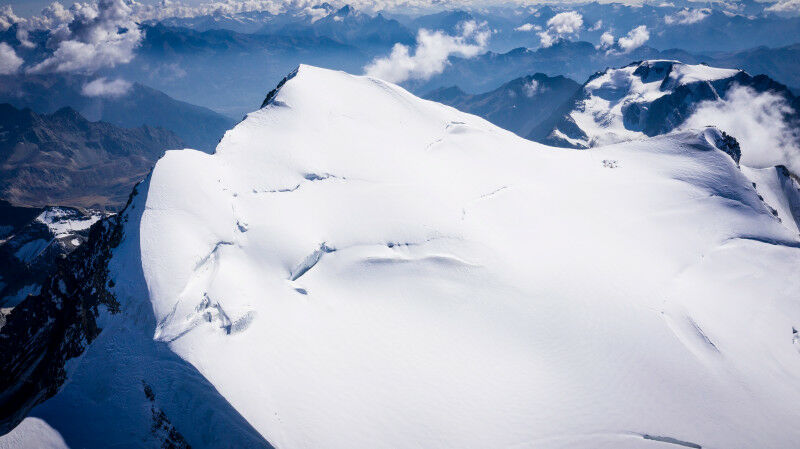
Even the «eternal ice» on the Grand Combin is not made to last forever. Visible at the upper right of the photo is the drilling camp of the 2020 Ice Memory ex-pedition led by PSI researcher Theo Jenk. (Photo: CNR, Ca’ Foscari University/Riccardo Selvatico)
Even the «eternal ice» on the Grand Combin is not made to last forever. Visible at the upper right of the photo is the drilling camp of the 2020 Ice Memory ex-pedition led by PSI researcher Theo Jenk. (Photo: CNR, Ca' Foscari University/Riccardo Selvatico) As part of the Ice Memory initiative, PSI researchers, with colleagues from the University of Fribourg and Ca- Foscari University of Venice as well as the Institute of Polar Sciences of the Italian National Research Council (CNR), analysed ice cores drilled in 2018 and 2020 from the Corbassière glacier at Grand Combin in the canton of Valais. A comparison of the two sets of ice cores published in Nature Geoscience shows: Global warming has made at least this glacier unusable as a climate archive. Reliable information about the past climate and air pollution can no longer be obtained from the Corbassière glacier in the Grand Combin massif, because alpine glacier melting is progressing more rapidly than previously assumed. This sobering conclusion was reached by researchers led by Margit Schwikowski, head of the Laboratory for Environmental Chemistry at PSI, and Carla Huber, PhD candidate and first author of the study, when they compared the signatures of particulate matter locked in the annual layers of the ice. Glaciers are invaluable for climate research.
TO READ THIS ARTICLE, CREATE YOUR ACCOUNT
And extend your reading, free of charge and with no commitment.