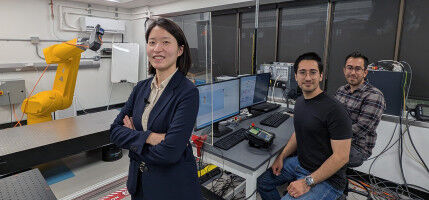
Grace Gu is engineering AI-optimized, bioinspired materials
CITRIS and the Banatao Institute Creating information technology solutions for society's most pressing challenges The CITRIS principal investigator and assistant professor of mechanical engineering takes inspiration from nature and uses machine learning to create more efficient materials. -CITRIS is really unique because it facilitates new collaborations in the UC system,- said Grace Gu , an assistant professor of mechanical engineering at the University of California, Berkeley, and a principal investigator (PI) at the Center for Information Technology Research in the Interest of Society and the Banatao Institute (CITRIS). -I wanted to explore a new area of research, and a CITRIS Seed Award opened doors to new partnerships and opportunities. Gu, who joined the UC Berkeley faculty in 2018, leads a research group that uses artificial intelligence (AI), advanced computational analysis and inspiration from biological structures to engineer better materials and improve additive manufacturing techniques. Gu has been interested in finding meaningful applications of her work - a core tenet of the CITRIS mission - since her days as an undergraduate mechanical engineering major at the University of Michigan, where her senior capstone team designed and patented a minimally invasive skin biopsy device to help make an uncomfortable process easier for patients and clinicians. Gu-s research in bioinspired materials began in graduate school at the Massachusetts Institute of Technology (MIT). During her doctoral studies, she investigated the structure of bone, alligator skin and different types of seashells, including the exceptional architecture of conch shells.