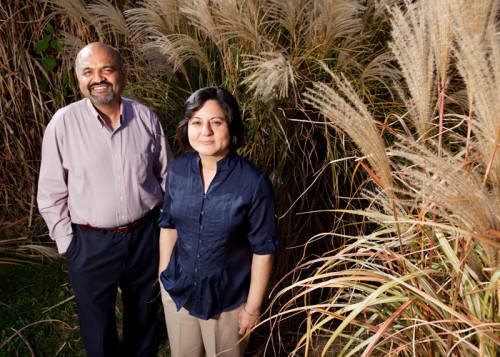
Illinois professors Atul Jain, left, and Madhu Khanna studied geographic yield and breakeven costs for producing large grasses as a bioenergy crop in the Midwestern United States.
CHAMPAIGN, Ill. Money may not grow on trees, but energy could grow in grass. Researchers at the University of Illinois have completed the first extensive geographic yield and economic analysis of potential bioenergy grass crops in the Midwestern United States. Demand for biofuels is increasing as Americans seek to expand renewable energy sources and mitigate the effects of fluctuating energy prices. Corn ethanol is the main biofuel on the market, but demand for ethanol competes with corn's availability as a food, and rising ethanol consumption could lead to higher food costs. In recognition of this problem, federal regulations mandate that 79 billion liters of biofuels must be produced annually from non-corn biomass by 2022. Large grasses, such as switchgrass and miscanthus, could provide biomass with the added benefits of better nitrogen fixation and carbon capture, higher ethanol volumes per acre and lower water requirements than corn.
TO READ THIS ARTICLE, CREATE YOUR ACCOUNT
And extend your reading, free of charge and with no commitment.