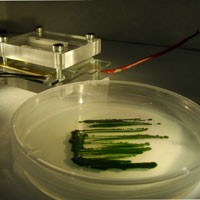
Biological photovoltaic device (background) and a culture of unicellular green algae (foreground). Copyright University of Cambridge.
Visitors to this year's Royal Society Summer Exhibition will have a chance to discover how scientists from the University of Cambridge are studying ways to harness algae as a renewable energy source. Part of the Cambridge team - which includes plant scientists, biochemists, mathematicians, and chemical engineers - is developing a biophotovoltaic device to produce green electricity by tapping into the ability of algae to harness solar energy. This is the first time that whole cells of algae have been used to power an electrical device. Although the technology is at least 5-10 years away from market the team has already succeeded in hooking up thin films of algae to power an electronic clock. According to Paolo Bombelli, a member of the Cambridge team which invented the original concept: "Compared with silicon-based photovoltaic cells, a solar cell that uses biological material to capture light energy would be cheaper to produce, self-repairing, self-replicating, biodegradable and much more sustainable - real green energy." Algae, like other green plants, use photosynthesis to take electrons from water using energy from the sun. The challenge for the Cambridge team is to find the best way of harvesting some of those electrons. The Cambridge exhibit - Meet the Algae - features other ways in which algae could be exploited, including for production of biodiesel and high-value products such as vitamins.
TO READ THIS ARTICLE, CREATE YOUR ACCOUNT
And extend your reading, free of charge and with no commitment.