Memories help animals survive by guiding them toward what to seek and what to avoid, such as remembering the smell of food or warning signs of danger. But in a constantly changing world, memories must also remain flexible. If a reward or threat no longer holds the same meaning, the brain needs ways to update what it has learned without completely forgetting the past.
Insights from fruit flies
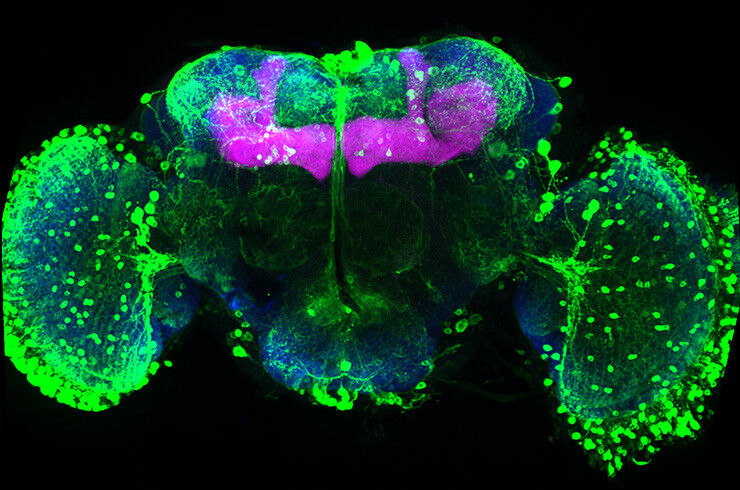
A new study from the Felsenberg lab at FMI shows that in fruit flies, simply re-experiencing a sugar reward can weaken all memories associated with it. Researchers trained flies to associate certain odors with sugar. Later, when flies encountered sugar again - without any odor - they were less likely to approach the odor they had previously learned to seek. Yet the memory itself was not entirely erased: brain activity revealed that the original memory trace remained, but its influence on behavior was abolished.
Context matters
Whether memory weakening occurred depended on context. When sugar was presented in a familiar environment, learned responses faded. When sugar appeared in a less familiar setting, or if flies learned something new at the same time, the memory remained intact. This suggests the brain uses environmental cues to decide when memories should be updated.
Beyond dopamine
Natural sugar re-exposure weakened memories without relying on dopamine, a neurotransmitter linked to reward and learning. Another key finding was that re-experiencing sugar weakened all memories tied to that specific reward. This may allow the brain to reassess the relevance of past experiences when circumstances change.
Relevance to mammals and humans
Although the experiments were done in fruit flies, similar principles have been observed in mammals and humans, particularly in studies of fear and addiction, says FMI group leader Johannes Felsenberg. “By showing that memories can be suppressed rather than erased - and that context determines when this happens - our work provides new insight into how brains balance stability with flexibility,” he says.
Implications for future research
Understanding these mechanisms could help develop strategies to reduce the impact of harmful aspects of memories without destroying them entirely.
Reference:
Carolin Warnecke, Johanna A. Schweizer, Benedetta Zattera, Dennis Goldschmidt, Kerstin Leptien, Johannes Felsenberg. Re-exposure to reward re-evaluates related memories. Current Biology 36, 565‑575 (2026).