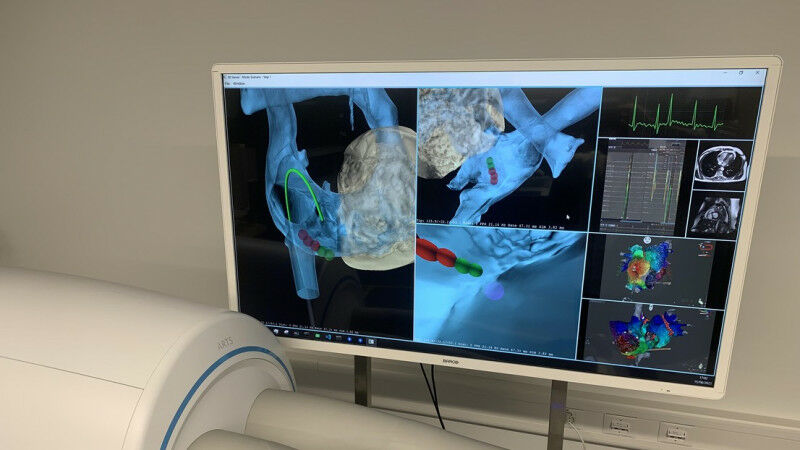
 Cardiac intervention simulator
Cardiac intervention simulator © EPFL 2023 EPFL is collaborating with academic and industrial partners to develop a cardiac intervention simulator. This platform is designed to train interventionalists in much the same way as flight simulators are used to train pilots. More and more cardiac interventions are now performed by inserting a small tube called a catheter into a blood vessel in the arm or groin, and from there into the heart chambers. This is much less traumatic than open heart surgery, but training young doctors to do this takes a long time. Enter the HEARTS (Heart Augmented Reality Training System) project, in which researchers from EPFL's Computer Vision Laboratory (CV Lab) in the School of Computer and Communication Sciences (IC), physicians from the interventional MRI center of the Cardiology Division of Lausanne's University Hospital (CHUV), and the Swiss company ADIS are jointly developing an Augmented Reality training system to enable doctors to practice on virtual 3D models of real patients' hearts. ADIS is in charge of developing the cardiac intervention simulator that allows a trainee to insert a real catheter into the "patient", which is nothing more than an empty box monitored by cameras observing the moving catheter. Its motion is transcribed into a 3D model of the catheter that is then inserted into a 3D heart model.
TO READ THIS ARTICLE, CREATE YOUR ACCOUNT
And extend your reading, free of charge and with no commitment.
Your Benefits
- Access to all content
- Receive newsmails for news and jobs
- Post ads