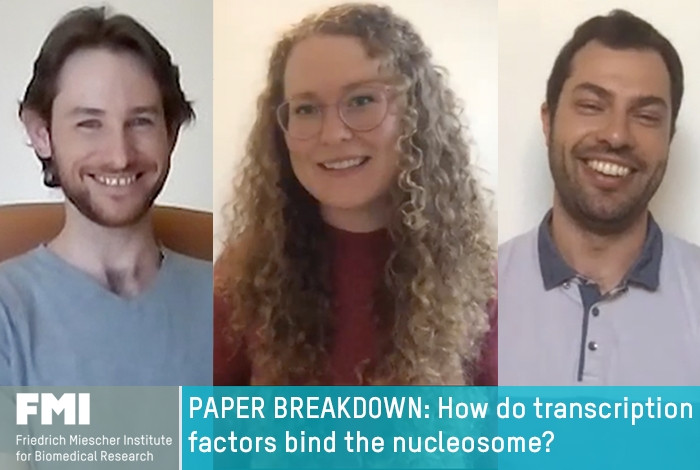
From left to right: Luke Isbel, Alicia K. Michael, Ralph S. Grand
From left to right: Luke Isbel, Alicia K. Michael, Ralph S. Grand - In a video (5'35'') combining interviews and figures, the team behind the latest collaboration from the Thomä and Schübeler labs - Alicia Michael, Ralph Grand and Luke Isbel - explain how they developed an assay identifying where the preferable sites for the transcription factor-DNA binding motif on the nucleosome were, so that they could build transcription factor-nucleosome complexes. The DNA in our cells is wrapped around histone proteins to form nucleosomes, and then further condensed into chromatin, which helps to package the DNA in the nucleus and plays a role in the regulation of gene expression. While it has long been known in the field of epigenetics that transcription factors must be able to find and bind to their DNA binding motifs in the context of chromatin, until now it was not known how this was happening or what this looked like. In a video (5'35''), the team behind the latest collaboration from the Thomä and Schübeler labs, Alicia Michael, Ralph Grand and Luke Isbel, explain how they developed an assay identifying where the preferable sites for the transcription factor DNA binding motif on the nucleosome were, so that they could build transcription factor-nucleosome complexes. This assay revealed high affinity binding sites for a pair of pioneering transcription factors, Oct4 and SOX2, and enabled the determination of cryo-EM structures of OCT4-SOX2 bound to DNA within a nucleosome.
TO READ THIS ARTICLE, CREATE YOUR ACCOUNT
And extend your reading, free of charge and with no commitment.