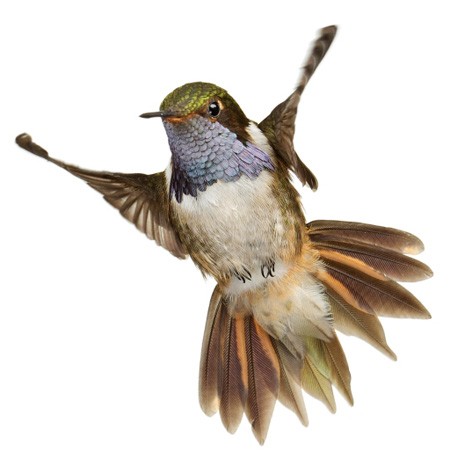
A volcano hummingbird (Selasphorus flammula) photographed on Cerro de la Muerte in Costa Rica. This species of bee hummingbird uses its modified tail feathers to produce sound during its aerial courtship displays. Anand Varma photo.
A newly constructed family tree of the hummingbirds, published today in the journal Current Biology , tells a story of a unique group of birds that originated in Europe, passed through Asia and North America, and ultimately found its Garden of Eden in South America 22 million years ago. These early hummingbirds spread rapidly across the South American continent, evolved iridescent colors - various groups are known today as brilliants, topazes, emeralds and gems - diversified into more than 140 new species in the rising Andes, jumped water gaps to invade North America and the Caribbean, and continue to generate new species today. "Our study provides a much clearer picture regarding how and when hummingbirds came to be distributed where they are today,” said lead author Jimmy McGuire, a UC Berkeley associate professor of integrative biology and curator of herpetology (reptiles and amphibians) in the campus's Museum of Vertebrate Zoology. There are now 338 recognized hummingbird species, but that number could double in the next several million years, according to the study's authors, who come from UC Berkeley, Louisiana State University and the universities of New Mexico, Michigan and British Columbia. "We are not close to being at the maximum number of hummingbird species,” McGuire said. "If humans weren't around, they would just continue on their merry way, evolving new species over time. Hummingbird ancestors arose in Eurasia 42 million years ago For more than 12 years, McGuire and his colleagues collected DNA data from 451 birds representing 284 species of hummingbirds and their closest relatives, ultimately sequencing six nuclear and mitochondrial genes.
TO READ THIS ARTICLE, CREATE YOUR ACCOUNT
And extend your reading, free of charge and with no commitment.