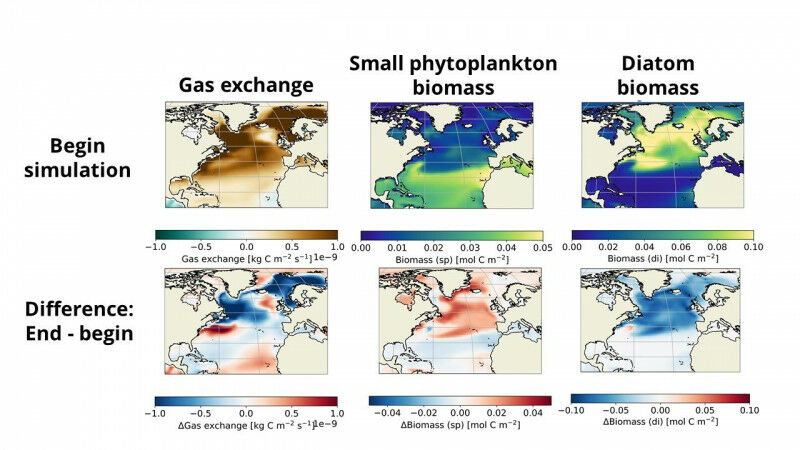
A steeply increasing atmospheric CO2 concentration will cause a shift in gas exchange in the ocean (left), a decrease of phytoplankton (middle) and an increase of diatom plankton (right).
A steeply increasing atmospheric CO2 concentration will cause a shift in gas exchange in the ocean ( left ), a decrease of phytoplankton ( middle ) and an increase of diatom plankton ( right ) . Increasing concentration of CO2 and global warming could lead to a shift of the dominant plankton population in the ocean, intriguing new research shows. If CO2 emissions into the atmosphere remain high until the year 2100, a different type of plankton will become the dominant species in the North Atlantic Ocean. This shift in plankton populations will also have an additional negative effect as less carbon will be stored in the deep ocean waters. As result, more of the emitted CO2 will remain in the atmosphere, Amber Boot, Anna von der Heydt and Henk Dijkstra (NESSC/IMAU) illustrate in a paper published today in Geophysical Research Letters. Plankton - the collective name for a wide range of different organisms living in ocean waters - plays an important role in removing carbon from the atmosphere and storing it for thousands of years in the deep waters of the ocean. This biological process counteracts and slows down the still increasing concentration of CO2 in the earth's atmosphere.
TO READ THIS ARTICLE, CREATE YOUR ACCOUNT
And extend your reading, free of charge and with no commitment.