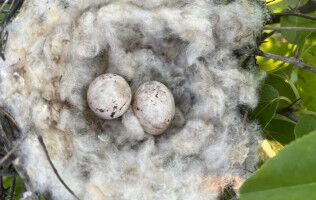
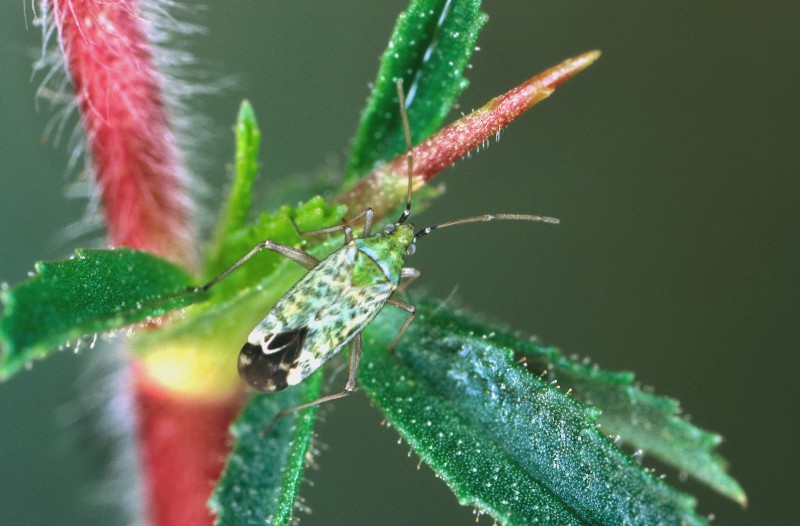
 The common restharrow or Ononis repens is a host plant for the insect Macrotylus paykulli, which feeds on its sap. Both disappear due to intensive land use.
Media releases, information for representatives of the media Media Relations (E) Intensive use of grasslands by humans reduces species diversity and makes the landscape more monotonous, so that the same species end up everywhere. Nature is then no longer able to provide us with many essential 'services', which range from soil formation for food production to pest control. Led by the Technical University of Munich and the University of Bern, 300 scientists studied the consequences of land-use intensification for biodiversity at the landscape level and for the first time could do this for a wide range of species groups. Normally, every meadow is different, with varying species finding a suitable habitat in different places. However, when grasslands are used very intensively by people only a few plants and animals can survive and this is the catalyst for an increasing loss of species. In previous studies, this effect was shown for particular groups, such as birds, within a particular habitat. But would land use not have a much greater effect on species loss if it were studied on a larger spatial scale and if the full diversity of life — from single-celled organisms to vertebrates — were included? In a study published in "Nature", scientists analysed and evaluated a unique data set with this question in mind.
TO READ THIS ARTICLE, CREATE YOUR ACCOUNT
And extend your reading, free of charge and with no commitment.
Your Benefits
- Access to all content
- Receive newsmails for news and jobs
- Post ads