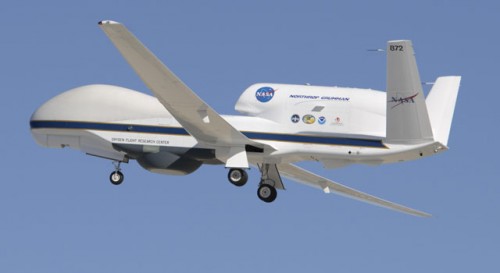
NASA’s Global Hawk soars aloft from Edwards Air Force Base, Calif., on a functional check flight of the WISPAR aircraft payload system and science instruments. Image credit: NASA Dryden Flight Research Center
They're called atmospheric rivers - narrow regions in Earth's atmosphere that transport enormous amounts of water vapor across the Pacific or other regions. Aptly nicknamed "rivers in the sky," they can transport enough water vapor in one day, on average, to flood an area the size of Maryland 0.3 meters (1 foot) deep, or about seven times the average daily flow of water from the Mississippi River into the Gulf of Mexico. The phenomenon was the subject of a recent major emergency preparedness scenario led by the U.S. Geological Survey, "ARkStorm," which focused on the possibility of a series of strong atmospheric rivers striking California - a scenario of flooding, wind and mudslides the USGS said could cause damages exceeding those of Hurricane Katrina in 2005. While atmospheric rivers are responsible for great quantities of rain that can produce flooding, they also contribute to beneficial increases in snowpack. A series of atmospheric rivers fueled the strong winter storms that battered the U.S. West Coast from western Washington to Southern California from Dec. 10 to 22, 2010, producing 28 to 64 centimeters (11 to 25 inches) of rain in certain areas. The atmospheric rivers also contributed to the snowpack in the Sierras, which received 75 percent of its annual snow by Dec.
TO READ THIS ARTICLE, CREATE YOUR ACCOUNT
And extend your reading, free of charge and with no commitment.